Cost of Living in Korea for a Foreigner (2026): Seoul vs Busan vs Regional Cities — Rent, Food, Transport, Phone, Insurance, With a Monthly Budget Calculator
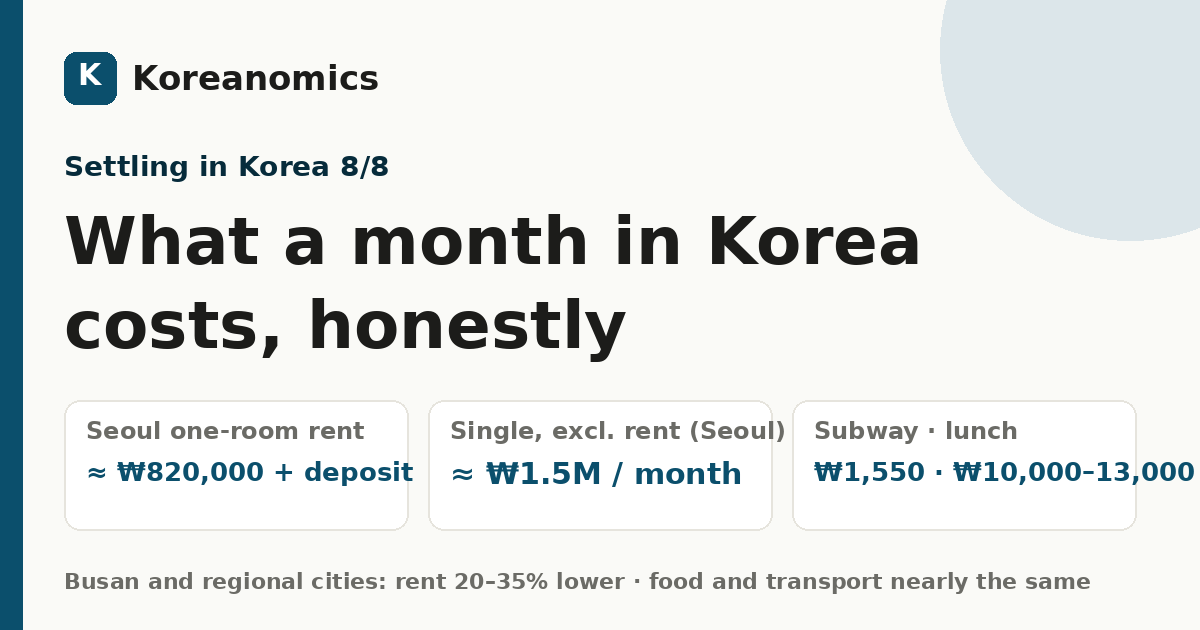
A single foreigner in Seoul spends about ₩1.5M a month before rent; a one-room averages ₩820,000. Busan and regional cities run 20–35% lower on rent.
Contents
This course has walked through the paperwork of arriving; this last part puts a number on living here. Korea is not a cheap country and not an expensive one — eating out, transport and phones are inexpensive by Western standards, rent in Seoul is not, and the deposit system front-loads the cost of a home in a way that surprises everyone. Below is a budget calculator built on 2026 figures with sources, then the line items and how they differ between Seoul, Busan and the regional cities.
Monthly budget calculator — single foreigner (2026)
Rent: Seoul one-room ≈ ₩820,000 (Q1 2026 average) with a ₩10M deposit; central officetel ≈ ₩1,188,235; Busan ≈ 25% lower, regional ≈ 35% lower. Utilities + management fee ≈ ₩150,000–270,000. Food from ₩450,000 (mostly cooking) to ₩1,000,000+. Transport ₩70,000–150,000. Phone ₩15,000–70,000. NHIS/pension deducted from salary for employees (Money Basics Part 1); shown here only for non-employees. Take-home ≈ 85% of gross at ₩3–5M.
Housing: the big variable
| Seoul | Busan | Regional cities | |
|---|---|---|---|
| One-room (원룸), monthly rent, ₩10M deposit | ≈ ₩820,000 (Q1 2026 average) | ≈ ₩550,000–650,000 | ≈ ₩400,000–550,000 |
| Officetel, central, furnished | ≈ ₩1,188,235 | ≈ ₩800,000–950,000 (Haeundae, Seomyeon) | ≈ ₩600,000–750,000 |
| Jeonse (deposit only) for a one-room | ≈ ₩217,000,000 | ≈ ₩120–170M | ≈ ₩80–130M |
| Goshiwon / shared room | ₩350,000–600,000 | ₩300,000–450,000 | ₩250,000–400,000 |
The deposit is the cost most budgets forget: ₩5–20 million for a wolse one-room, returned when you leave. The conversion is roughly ₩10 million of deposit for ₩40,000–50,000 of monthly rent, in either direction (Investing Part 6). Add a management fee (관리비) of ₩50,000–150,000 for a one-room or officetel, which typically covers water, cleaning and sometimes internet, and utilities of ₩50,000–120,000 (electricity, gas — heating in January is the expensive month). Employers who provide housing (public-school teachers, many E-9 employers, some E-7 contracts) remove the largest line entirely — value it at ₩700,000+ a month when comparing offers.
Food
Korea's daily food is inexpensive if you eat Korean. A lunch set at a neighbourhood restaurant is ₩9,000–13,000 in 2026; a bowl of noodles or gimbap ₩5,000–8,000; a Korean BBQ dinner for two ₩40,000–70,000; a café americano ₩4,500–5,500. Convenience-store meals run ₩4,000–7,000. Groceries are where Western habits cost money: imported cheese, beef, fruit and wine are pricey, while rice, vegetables, tofu, eggs, chicken and pork are cheap — a single person cooking most meals spends ₩300,000–450,000 a month; someone eating out twice a day, ₩800,000–1,000,000. Delivery apps add ₩2,000–4,000 a delivery.
Transport
₩1,550 a subway ride in Seoul (₩1,600 in Busan), ₩1,500 a bus, with free transfers within 30 minutes; a commuter spends ₩70,000–100,000 a month. Seoul's unlimited 30-day Climate Card (₩62,000) is being replaced in autumn 2026 by a national K-Pass-linked product; the K-Pass refund scheme (20–53% back on 15+ rides a month) is open to registered foreigners with a Korean card. Taxis start at ₩4,800 and a cross-town ride is ₩15,000–25,000; a car adds ₩300,000–500,000 a month in fuel, insurance, parking and tax (Part 7). KTX Seoul–Busan is ₩54,400 each way after the September 2026 fare cut.
Phone, internet, subscriptions
A MVNO plan is ₩10,000–30,000, a carrier plan ₩45,000–90,000 (Part 3); home internet ₩22,000–40,000 unless included in the management fee; streaming and music at global prices. Gyms are ₩50,000–100,000 a month (much less on a 6-month contract); Pilates, golf lessons and climbing gyms are where Seoul discretionary spending goes.
Insurance and tax
For employees these are payroll deductions, not budget lines: about 9.7% of gross for the four insurances plus income tax (Money Basics Part 1); take-home is ≈ 85% of gross at ₩3–5M a month. Non-employees on a long-term visa pay NHIS themselves — ₩158,630 a month minimum for a foreign regional subscriber, half that for students (Money Basics Part 6).
Seoul vs Busan vs the regions
Seoul is 25–35% more expensive than Busan and the regional cities, and almost all of the difference is rent; a Busan one-room at ₩600,000 versus Seoul's ₩820,000, an officetel in Haeundae at ₩850,000 versus Gangnam's ₩1.2M+. Food, phones, insurance and subscriptions are national prices. Transport is a wash (Busan's fares are marginally higher, its distances shorter). What the regions lack is not affordability but the foreigner infrastructure — English-speaking clinics, international schools, the branch that has opened a foreigner's account before — which is why Parts 2–4 of this course matter more in Ulsan than in Itaewon.
The one number to remember
A single foreigner living modestly — a one-room outside the centre, cooking half the time, no car — spends about ₩2.3–2.5 million a month in Seoul including rent, ₩1.9–2.1 million in Busan and ₩1.7–1.9 million in a regional city. On the E-7 salary floor (₩2.6M gross, ≈ ₩2.2M net) that is break-even in Seoul and comfortable elsewhere; on ₩4M gross it leaves ₩800,000–1,200,000 a month to save or remit (Part 5). Korea's cost of living is manageable; what it punishes is arriving without the deposit.
That closes the settling-in course. The travel course — for the friends who visit — starts with the entry rules that changed in 2025 and 2026.
Frequently asked questions
What is a comfortable salary for a single person in Seoul?
The arithmetic in this part gives about ₩2.3–2.7M a month of spending for a modest single life in Seoul with a one-room, and ₩3–3.5M for an officetel in a central district with some eating out. Since take-home is roughly 85% of gross at these levels (Money Basics Part 1), that means a gross salary of ₩3.2M for the modest version and ₩4M+ for the comfortable one — which is why the E-7 salary floor of ₩31.1M a year (≈ ₩2.6M a month) is tight in Seoul and fine in Daejeon.
How much is the deposit for a rental?
For monthly rent (wolse) a deposit of ₩5–20 million is typical for a one-room in Seoul — larger deposit, lower rent, at the legal conversion rate of about 5% a year (Investing Part 6). Landlords rarely accept less than ₩5M. Jeonse (deposit-only, no rent) for a one-room runs ₩150–250M in Seoul, which few new arrivals have; the deposit is returned in full when you leave.
Is Busan really cheaper?
On housing, clearly: comparable one-rooms and officetels rent for 20–35% less, and Haeundae's premium is still below Gangnam's. On everything else, only slightly — chain restaurants, supermarkets, phone plans and NHIS cost the same nationwide, and Busan's subway base fare (₩1,600) is higher than Seoul's (₩1,550). The saving is real but it is a rent saving.
Where do these numbers come from?
Rent: KB and Korea Real Estate Board averages for one-rooms and officetels (Q1 2026). Transport: Seoul and Busan city fare notices. Food, utilities and the 'single person excluding rent' total: Numbeo's Seoul dataset as of September 2026, cross-checked against the Korea Consumer Agency's price index for lunch and coffee. They are averages; a foreigner in Itaewon spends more and a student in Sillim spends less.
Sources
- Daily Pop — Seoul one-room and officetel average monthly rent, Q1 2026 (Korea Real Estate Board data)
- Money Today — Seoul officetel jeonse/wolse averages, May 2026
- Numbeo — Cost of living in Seoul (September 2026)
- Korea Herald — Seoul subway fare ₩1,550 from June 28, 2025
- Seoul Metropolitan Government — taxi fares (base ₩4,800)
※ This article summarises publicly available rules as of the date shown. Your situation may differ; confirm with the relevant Korean authority (National Tax Service, Ministry of Employment and Labor, National Pension Service, Immigration) or a licensed professional before making decisions.