Sending Money Home from Korea (2026): The $50,000 Rule for Foreigners, Bank Wire vs Remittance Apps, What Documents Unlock Unlimited Transfers — Cost Calculator
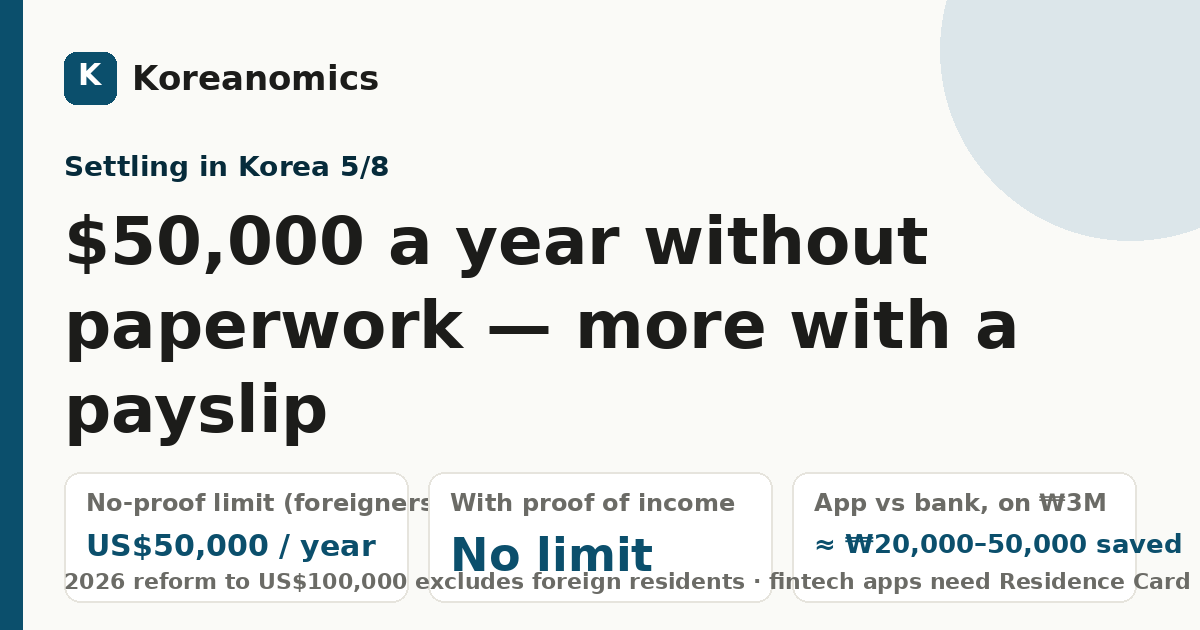
Foreign residents can remit US$50,000 a year with no paperwork, and unlimited Korean income with a payslip. The 2026 $100,000 reform is for Koreans only.
Contents
For most foreign workers this is the transaction that matters: turning won into dollars, pesos, dong, rupees or euros at home. Korea makes it easy up to a point and paper-heavy beyond it, and in 2026 the rules for Koreans changed in a way that produced a wave of wrong English headlines. This part gives the actual limits for foreign residents, the documents that remove them, and a calculator that shows what a bank wire really costs against the apps.
Remittance cost comparison — bank wire vs app (2026)
Received amount = (amount − fees) ÷ (mid-rate × (1 + spread)). Enter the quotes from your own bank and app — the calculator only does the arithmetic. Licensed small-remittance apps: max US$5,000 per transfer, US$50,000 a year. Banks may also charge the receiving side (OUR vs SHA).
The limits for foreign residents
Under the Foreign Exchange Transactions Regulations a foreign resident (a foreigner living in Korea, whatever the visa) may send abroad:
- Up to US$50,000 per calendar year with no proof of source — passport and Residence Card at the bank counter, or in-app. The bank records each transfer against your passport number, and all banks and apps share the count.
- Unlimited amounts of documented Korean income — salary, severance, deposit refunds, sale proceeds — by showing where the money came from: employment certificate or contract, payslips or the year-end withholding receipt, a sale contract and bank record for property or a car. Documented transfers do not count toward the $50,000.
That is the whole rule. Remitting the money you earned here is not restricted; the paperwork exists so that the bank can show a regulator the money was yours. Keep every payslip and the February withholding receipt (Money Basics Part 3) — they are the documents the counter asks for.
The 2026 reform is not for you. In January 2026 Korea raised Korean nationals' no-documentation limit to US$100,000 a year combined across banks and fintechs and launched a cross-sector monitoring system (ORIS). The Federation of Banks' own rule page is titled "residents, excluding foreign residents". Foreign residents remain on the $50,000 rule above. English guides that celebrate "$100,000 for foreigners" are wrong.
Two smaller rules: cash over US$10,000 leaving the country must be declared at customs, and transfers over US$10,000 a year per recipient are reported by the bank to the tax office as a matter of course (it is a report, not a tax).
Bank wire vs remittance app
| Bank (SWIFT) | Licensed remittance app | |
|---|---|---|
| Who | KB, Shinhan, Woori, Hana, NH … | Sentbe, GME, Hanpass, WireBarley, E9pay, Wise (KR), Coinshot, and ~25 others licensed by the MOEF |
| Fee | ₩10,000–30,000 + US$15–30 intermediary + receiving bank charge | ₩0–5,000 flat; some corridors free |
| Rate | Bank rate with a 1–1.5% spread, partly discounted ("우대 환율") for salary customers | 0.3–1% over mid-market |
| Speed | 1–3 business days | Minutes to same day (Philippines, Vietnam, Nepal, India, Indonesia), 1–2 days for bank deposits in the US/EU |
| Limits | None with documents | US$5,000 per transfer, US$50,000 a year |
| Sign-up | Branch, passport, Residence Card | App, Residence Card scan, Korean bank account, face verification |
| Best for | Large or documented transfers; property proceeds; corridors apps do not serve | Everything else |
On ₩3 million the difference is typically ₩20,000–50,000 in the app's favour; on ₩300,000 the bank wire's fixed fees can eat 15% and an app 2%. The apps' business is exactly the E-9 and E-7 monthly remittance; WireBarley's published SWIFT fees (₩3,000 under ₩3M, free over ₩5M, ₩15,000 for OUR) illustrate the scale. Wise, which most Westerners know, operates in Korea through a licensed local entity with the same $5,000/$50,000 caps.
Apps to avoid: anyone who asks you to hand cash to a person, or to send won to a private individual's Korean account "for exchange". Unlicensed hawala-style remittance is illegal for both sides and is the vehicle for most foreign-worker fraud cases; the Ministry of Economy and Finance publishes the list of licensed small-remittance firms.
Using the bank well
If you do wire from a bank: register the receiving account once as a designated remittance (지정 송금) at the counter with your documents, after which the app sends to it without a visit; ask for the preferential rate (환율 우대) your salary account entitles you to — 50–90% of the spread is negotiable at most banks for salary customers; and choose OUR (sender pays all fees) only when the recipient must receive an exact amount. Big transfers on leaving Korea — severance, deposit, the pension refund that arrives after departure — are covered step by step in Money Basics Part 14.
Receiving money in Korea
Inbound is simpler: no limit on receiving your own funds from abroad into a Korean account; over US$10,000 the bank will ask the purpose and may ask for a document, and gifts or investments are reported. Foreign currency accounts (외화예금) let you hold dollars in Korea without converting; Toss and the major banks open them in-app.
The next part leaves money for the small paperwork of a Korean address: rubbish bags, recycling, the road-name address and getting the utilities into your name.
Frequently asked questions
Didn't Korea raise the no-documents limit to $100,000 in 2026?
For Korean nationals, yes: from January 2026 residents can remit up to US$100,000 a year across banks and fintechs without proving the source. The Korea Federation of Banks' own page titles the rule 'residents (excluding foreign residents)'. Foreign residents stay on the separate rule: US$50,000 a year on a passport, and beyond that, documents showing the money is Korean income. Several English guides got this wrong.
What documents let me send more than $50,000?
Proof that the funds are your legitimate Korean income: a certificate of employment (재직증명서) or employment contract, recent payslips or the withholding receipt (원천징수영수증), and for sale proceeds a contract and bank record. With these there is no ceiling — you can remit your entire severance, deposit refund or savings. The bank records the transfer against your passport so it is not counted toward the $50,000.
Which is cheaper, my bank or an app?
An app, almost always, for amounts under about ₩10 million: licensed small-remittance firms (Sentbe, GME, Hanpass, WireBarley, E9pay, Wise's Korean service) charge a flat fee of ₩0–5,000 and a rate spread of 0.3–1%, and deliver in minutes to hours for major corridors. A bank wire costs ₩10,000–30,000 plus a US$15–30 intermediary fee and a 1%+ spread, and takes 1–3 days. Banks win only for very large sums, for property proceeds needing documentation, and for corridors the apps do not serve.
Is there a limit per transfer at the apps?
Licensed small-remittance providers are capped at US$5,000 per transaction and US$50,000 a year per customer (the same number as the no-proof limit, by design). Above that you use a bank. Some apps also apply their own lower daily caps for new accounts.
Sources
- Woori Bank — Overseas remittance by foreign residents: US$50,000 without documents, documents beyond
- Korea Federation of Banks — 2026 remittance limit for residents (excluding foreign residents)
- korea.kr — January 2026 foreign-exchange reform: US$100,000 no-documentation limit, ORIS monitoring
- WireBarley — Korea outbound fee schedule (SWIFT SHA/OUR)
- Foreign Exchange Transactions Regulations, Art. 4-3 (payments by foreign residents)
※ This article summarises publicly available rules as of the date shown. Your situation may differ; confirm with the relevant Korean authority (National Tax Service, Ministry of Employment and Labor, National Pension Service, Immigration) or a licensed professional before making decisions.