Opening a Korean Bank Account as a Foreigner (2026): Documents, the ₩1M/Day Limited Account and How to Lift It, Toss vs KakaoBank, Cards
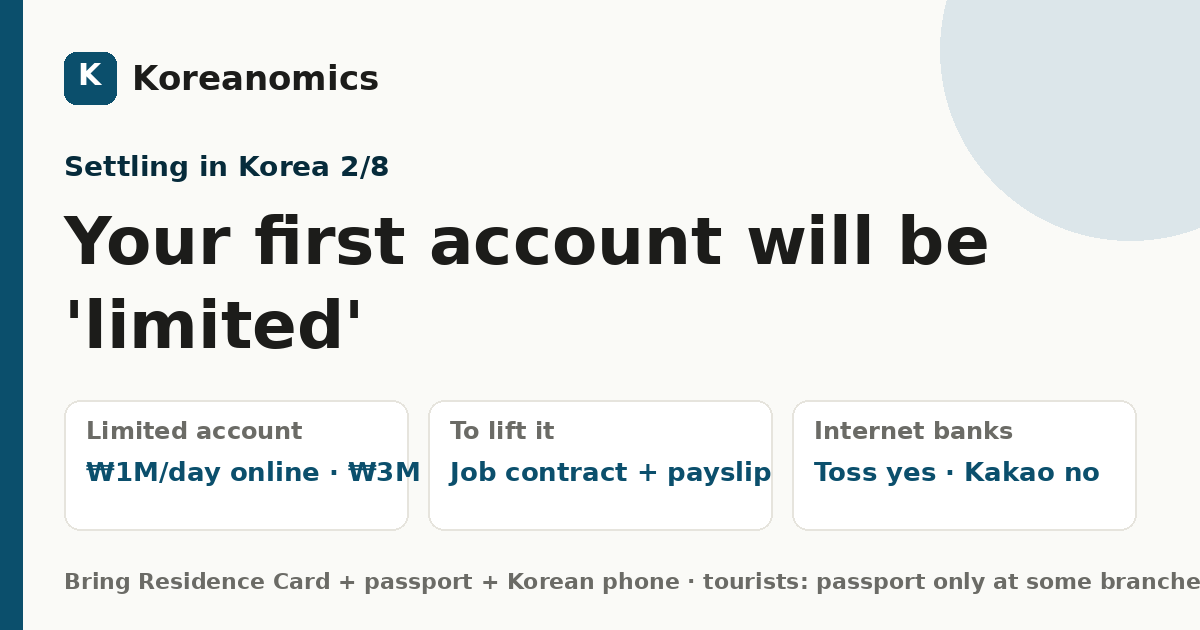
With a Residence Card any major bank opens an account, but it starts limited (₩1M/day online) until you show a job. Toss takes foreigners; KakaoBank does not.
Contents
A Korean bank account is easy to open and surprisingly hard to use at first. The account itself takes twenty minutes at a branch with your Residence Card; then you discover it is a limited-transaction account that refuses to send more than ₩1,000,000 a day, that your foreign phone number cannot register for the app, and that the internet bank your Korean colleagues use will not have you. This part explains each of those, in the order you will hit them.
What can you open right now? (2026)
Limited-account daily caps: ₩1,000,000 online/ATM, ₩3,000,000 at the counter. Lifting requires proof of purpose (job, study, lease) or a few months of salary history. Internet banks: Toss Bank accepts foreign residents; KakaoBank does not (mid-2025); K Bank unconfirmed. Branch policies for passport-only accounts vary — treat as best-effort.
Which bank
For a first account, choose by branch, not brand: the branch near your home or office that sees foreigners regularly. KB Kookmin, Shinhan, Woori and Hana are the big four; all have English app modes and foreigner desks at major branches (Itaewon, Gangnam, Hongdae, Busan Haeundae). Woori and Hana have the reputation of being the most relaxed with incomplete paperwork; KB and Shinhan have the widest ATM networks. NH (농협) and the regional banks (Busan Bank, Daegu Bank/iM) are fine if your employer uses them — your salary bank is where the limit gets lifted fastest.
Bring: Residence Card (or the registration receipt and passport), passport, a Korean phone number in your name if you have one (needed for the app and for OTP), and whatever proves the account's purpose (below). Say what the account is for — "salary", "tuition", "rent" — because the bank records a purpose and it determines the limits.
The limited account, and how to lift it
Since 2024's anti-fraud rules, every new account opens as a 한도제한계좌 with daily caps of ₩1,000,000 for ATM withdrawals and online transfers and ₩3,000,000 at the counter. It applies to Koreans as well; for a foreigner it is simply the default state. The cap is removed when you show the bank a reason for the money flow:
- Employees: employment contract or certificate of employment (재직증명서) plus a recent payslip. Many banks lift the limit on the spot if you bring these to the opening.
- Students: enrolment certificate and a tuition invoice or scholarship letter.
- Tenants: the lease, for the deposit transfer (the bank may lift the limit for that single transaction).
- Everyone else: two or three months of salary or regular deposits into the account usually qualifies you to ask again.
A lifted account is called a normal (정상) account; ask explicitly — "한도 해제 부탁드립니다" — because the default is to leave the limit in place.
Phone before app
The bank app, OTP by SMS, and every identity check in Korea (본인인증) run through a phone contract in your name. A foreign number will not register. So the practical order is: open the account with the plastic card and a passbook; get the phone contract in Part 3 (the phone shop needs the bank account for autopay); return to the bank app and register the Korean number. Two visits, unavoidable.
Internet banks
Toss Bank has taken foreign residents since 2024 — Residence Card scan plus Korean phone number, no branch — and its app is the most foreigner-friendly interface in Korean banking. KakaoBank did not accept foreign customers as of July 2025 and has not announced a change. K Bank's policy is unconfirmed; ask in the app. None of the three lifts the limited-account rule by itself, and none can serve as your salary bank for the documents most employers want, so the typical setup is a traditional bank for salary and Toss for daily use.
Cards and payments
A debit card (체크카드) comes with the account, works domestically everywhere and internationally if you ask for a Visa/Mastercard-branded one. Payment apps — Samsung Pay, Naver Pay, Kakao Pay — register a Korean debit or credit card on an identity-verified phone; Apple Pay works with a small set of Korean card issuers. Credit cards need a track record: most banks want 6–12 months of salary at the bank, a visa with at least a year left, and sometimes a security deposit. Foreign credit cards are accepted at most shops but not at some transit gates, government kiosks and small restaurants, which is why Part 3's phone and this part's debit card come before anything else.
Sending money out, closing
Outbound remittance from a Korean account is covered in Part 5: the short version is that a foreign resident can remit US$50,000 a year without documents and unlimited amounts with proof of income. Closing an account is at the branch with your card and ID; do it before you leave Korea, because most banks will not close or operate a foreign customer's account by post (Money Basics Part 14).
The next part gets you the phone number that unlocks the app, the delivery services and the identity checks.
Frequently asked questions
Can I open an account without a Residence Card?
Some branches of the big banks (Woori, Hana, KB, Shinhan) will open a basic deposit account on a passport alone for a short-term visitor, but it will be a limited-transaction account with no internet banking and often no card. Policies vary by branch and change often; the reliable path is the Residence Card. With the registration receipt you can usually open the account and add internet banking once the card arrives.
Why can't I transfer more than ₩1,000,000 a day?
Every new account in Korea — for Koreans too — opens as a limited-transaction account (한도제한계좌) under the anti-voice-phishing rules: ₩1,000,000 a day by ATM or online, ₩3,000,000 at the counter. It is lifted when you show the bank the purpose of the account: an employment contract or certificate plus a payslip, a student enrolment certificate with tuition invoice, or a lease for rent. Salary being paid into the account for a couple of months also does it at most banks.
Which is better for a foreigner, Toss Bank or KakaoBank?
Only one of them will have you. Toss Bank has opened accounts for foreign residents since 2024 with Residence Card verification; KakaoBank still did not accept foreign customers as of mid-2025. K Bank's position is unconfirmed. In practice most foreigners keep one traditional bank (for salary, the limited-account lift and a debit card) and add Toss for its app and transfers.
Can I get a credit card?
Usually after 6–12 months of salary history at the same bank, on an F-visa or E-7 with a contract running at least a year beyond the application; many banks require a Korean guarantor or a deposit-secured card for other visas. A debit card (체크카드) is issued on the spot with the account and works for almost everything, including online, once the account is unlimited.
Sources
※ This article summarises publicly available rules as of the date shown. Your situation may differ; confirm with the relevant Korean authority (National Tax Service, Ministry of Employment and Labor, National Pension Service, Immigration) or a licensed professional before making decisions.