Going to the Doctor in Korea as a Foreigner (2026): Clinic vs Hospital, What You Pay With and Without NHIS, English-Speaking Hospitals, Pharmacies and Emergencies
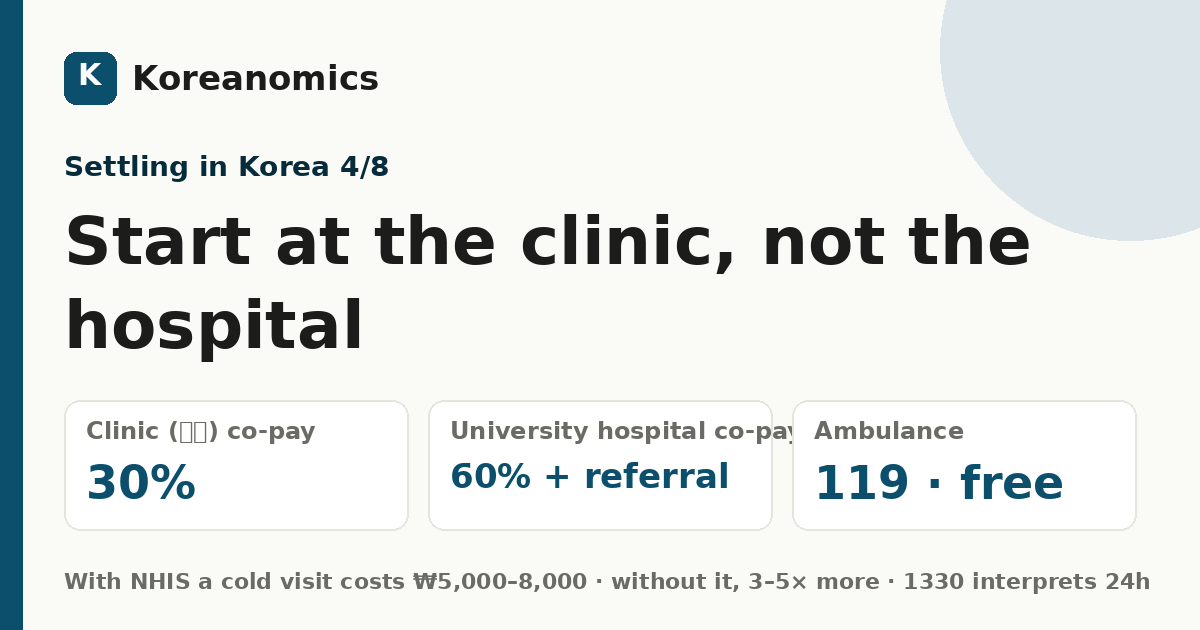
Korea's system starts small: a clinic (의원) costs a few thousand won with NHIS at 30% co-pay; big hospitals charge 60% and need a referral. Costs and English.
Contents
Korean healthcare is fast, cheap and organised around a rule most newcomers get backwards: go small first. The system is built as a pyramid — thousands of one-doctor clinics at the bottom, general hospitals in the middle, a few dozen university hospitals at the top — and it charges you more the higher you start, on purpose. This part explains the tiers, what each costs with and without insurance, where English is reliably spoken, how pharmacies and emergencies work, and the numbers to call.
What will a visit cost? (2026 co-payment estimator)
Outpatient co-payment rates by institution type; inpatient 20%; ER 20% for emergency cases (non-emergency: full ER charge). Non-covered items (비급여: some scans, ultrasound, cosmetic, private rooms, some newer drugs) are charged in full regardless. Typical clinic 총진료비 for a simple consultation ≈ ₩15,000–25,000, of which you pay 30%.
The tiers, and what each costs
| Tier | Korean | What it is | NHIS outpatient co-pay | Typical bill with NHIS |
|---|---|---|---|---|
| Clinic | 의원 | One specialist, walk-in, in every neighbourhood | 30% | ₩5,000–8,000 |
| Hospital | 병원 | 30–100 beds, several departments | 40% | ₩10,000–20,000 |
| General hospital | 종합병원 | 100+ beds, ER, most specialties | 50% | ₩15,000–30,000 + tests |
| University / tertiary | 상급종합병원 | The 47 top hospitals; referral needed | 60% | ₩30,000+ + tests |
| Inpatient (any) | 입원 | Admission | 20% | Room and board extra above the base ward |
The clinic is where 90% of your healthcare happens: 내과 for colds, stomach and general complaints, 이비인후과 for ears/nose/throat (Koreans go here for colds too), 정형외과 for bones and joints, 피부과 for skin, 산부인과 for women's health, 소아청소년과 for children, 안과 for eyes, 치과 for teeth. No appointment; register at the desk with your Residence Card (the NHIS lookup is by your number); consultation in 5–10 minutes; prescription printed; pharmacy in the same building. Ultrasound, X-ray and blood tests are done on site in many clinics.
Non-covered items (비급여) are the surprise on any bill: MRI outside NHIS criteria, some ultrasounds, newer drugs, cosmetic and dermatology procedures, private rooms, and — for dental — most crowns and implants (adults get NHIS on scaling once a year and on some implants over 65). Ask "급여예요, 비급여예요?" before a test if the price matters.
Without NHIS
Employees are insured from their first day; everyone else joins automatically after six months of residence (Money Basics Part 6), and can enrol earlier at an NHIS branch on most long-term visas. Until then you pay the full fee: a clinic consultation ₩15,000–30,000, a hospital outpatient visit ₩50,000–100,000 before imaging, an admission several hundred thousand won a day. Korean prices even without insurance are far below US and comparable to European private care, and every hospital issues an itemised receipt in a format that travel and employer insurers accept.
English-speaking care
The international clinics are the reliable route: Severance Hospital (Sinchon), Samsung Medical Center (Ilwon), Asan Medical Center (Songpa), Seoul National University Hospital (Hyehwa) and Seoul St. Mary's in Seoul; Pusan National University Hospital and Haeundae Paik in Busan; Chungnam National in Daejeon. They take walk-ins, assign an English-speaking coordinator, bill NHIS normally (plus a coordination fee at some), and can book you into any department of the hospital — but at tertiary-hospital co-pays, and the referral requirement is usually waived only within the international clinic itself.
For everyday clinic visits: Naver Map lists "영어 가능" for many clinics in Itaewon, Hannam, Yeonnam, Gangnam and Haeundae; many younger doctors read and write English well even when they speak it hesitantly, and a symptom typed into a translation app works. The 1330 travel hotline and 1345 immigration line both provide live interpretation over the phone, in the clinic, for free — put the phone on speaker.
Pharmacies
Prescriptions (처방전) are filled at any pharmacy (약국), usually the one downstairs, for a 30% co-pay — a course of antibiotics and cold medicine is typically ₩3,000–6,000. Pharmacists sell OTC medicines over the counter without a prescription: painkillers, cold remedies, antihistamines, digestive remedies, ointments. Convenience stores sell a short list of basics (Tylenol, some cold tablets, plasters) after 10 pm. Pharmacies near hospitals stay open late; the 휴일지킴이약국 site lists those open on Sundays and holidays.
Emergencies
119 is fire and ambulance, free, with an interpreter service the operator can add; 112 is police. The ambulance takes you to the nearest ER with capacity, which in 2024–2026 has sometimes meant a longer ride than expected because of the hospital staffing dispute — call 119 rather than driving to a hospital that may not accept you. ER co-pay is 20% of the ER charge for a case classified as an emergency; for a non-emergency the ER charge is billed in full, so at night with a fever, 119's advice line or a 24-hour 소아과/내과 (search "야간진료") is the cheaper first stop. The old 1339 medical hotline no longer exists; 119 absorbed it.
Two habits that pay off
Register your phone number and card with your main clinic and pharmacy so the NHIS lookup is instant, and keep the NHIS app (The건강보험) installed: it shows your premium status, lets you check a hospital's tier before you go, and books the free biennial health check that every subscriber is entitled to — the check-up letter arrives in Korean, but the app will show the booking in the year you are eligible.
The next part is the one that most foreign workers care about most: sending money home, and why the "$100,000 without documents" headline of 2026 does not apply to you.
Frequently asked questions
I have a cold. Do I go to a hospital?
No — to a 의원 (clinic), the single-doctor practice on the second floor of the building near your home, marked 내과 (internal medicine), 이비인후과 (ENT), 소아과 (paediatrics) or 가정의학과 (family medicine). No appointment, 10–30 minutes' wait, ₩5,000–8,000 with NHIS including a short prescription, and the pharmacy is downstairs. Hospitals (병원) are for procedures and admissions; the big university hospitals charge a 60% co-pay and mostly require a referral for outpatient visits.
How do I find a doctor who speaks English?
Three routes. The international clinics at the big Seoul hospitals — Severance (Sinchon), Samsung Medical Center, Asan Medical Center, Seoul National University Hospital — and Busan's Pusan National University Hospital take walk-in foreign patients with English coordinators, at hospital prices. Second, clinics near foreigner districts (Itaewon, Hannam, Haeundae) often list English on Naver Map. Third, for anything else, call 1330 or 1345 and put the operator on speaker as an interpreter — it works, and it is free.
What if I don't have NHIS yet?
You pay the full fee (수가) rather than 30–60% of it: a clinic visit becomes ₩15,000–30,000, a hospital outpatient visit ₩50,000–100,000 before tests. Employees are covered from day one; everyone else joins automatically at six months, and you can enrol earlier at an NHIS branch if you are on an eligible visa. Travel or employer private insurance reimburses afterwards; keep the itemised receipt (진료비 세부내역서).
Is the ambulance really free?
The 119 ambulance is a public service with no charge. Private ambulances (사설 구급차) that hospitals arrange for transfers cost ₩75,000 base plus distance. Emergency-room visits carry a co-pay of 20% of the ER charge for genuine emergencies, but if the ER decides you were not an emergency case you pay the ER fee in full, typically ₩50,000–100,000 before treatment — which is why the clinic-first rule matters at 2 a.m. too: 119 will tell you which hospitals are open.
Sources
- National Health Insurance Service — Coverage for foreigners and overseas Koreans (English)
- Health Insurance Review & Assessment Service — Co-payment rates by institution type (외래 본인부담률)
- Severance Hospital — International Health Care Center
- Korea Tourism Organization — 1330 Korea Travel Hotline (24h interpretation)
※ This article summarises publicly available rules as of the date shown. Your situation may differ; confirm with the relevant Korean authority (National Tax Service, Ministry of Employment and Labor, National Pension Service, Immigration) or a licensed professional before making decisions.