Korea Entry Requirements 2026: K-ETA (Who Is Exempt Until Dec 31, 2026), the e-Arrival Card, Visa-Free Days, Smart Entry Gates — Which Forms You Actually Need
Nationals of 22+ countries incl. the US, UK, EU, Japan and Australia skip K-ETA through Dec 31, 2026 but must file the e-Arrival Card before arrival. Checker.
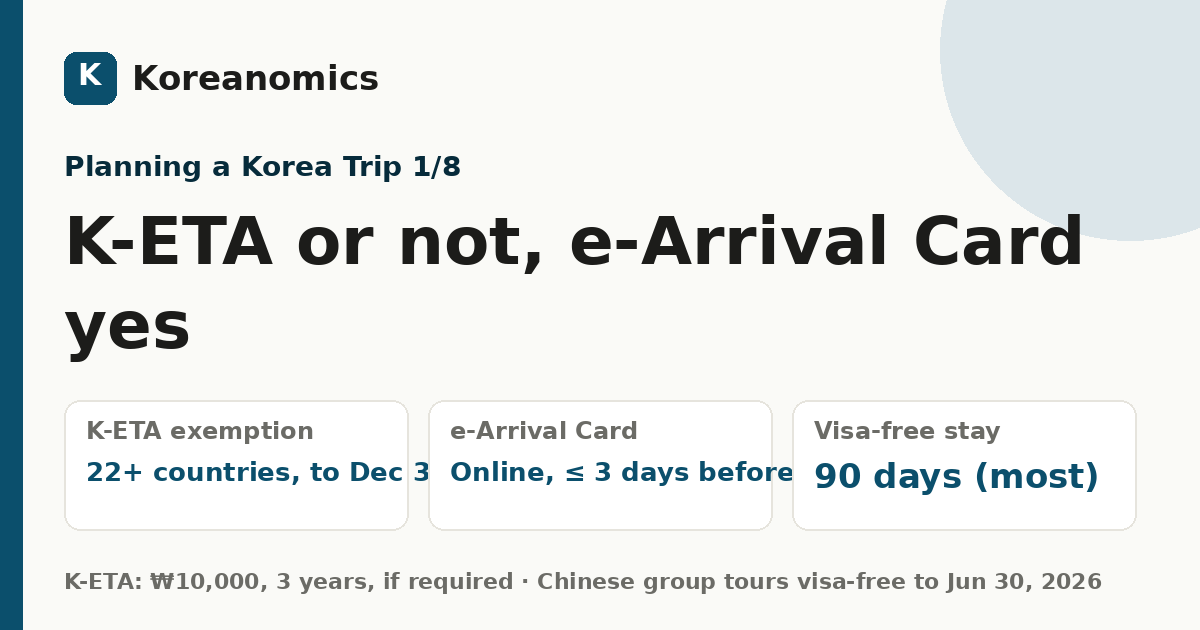
Korea changed its arrival paperwork three times between 2021 and 2025 — introducing the K-ETA, then exempting most Western and East Asian tourists from it, then replacing the paper arrival card with an online one — and the result is that the average blog post is wrong about at least one of them. As of September 2026 the rules are simple once you know which of two forms applies to you. This first part of the trip-planning course sorts it out, with a checker.
Which entry forms do I need? (September 2026 rules)
K-ETA exemption for the listed countries runs to 2026-12-31 (MOFA notices; extended annually so far). K-ETA where required: ₩10,000, valid 3 years, apply ≥ 72 h before departure. e-Arrival Card: online within 3 days before arrival, mandatory since 2025-02-24 unless exempt. Visa-free stay lengths vary by country — confirm yours on k-eta.go.kr or your nearest Korean mission.
The two forms
K-ETA (Korea Electronic Travel Authorization) is the pre-travel screen introduced in 2021 for visa-waiver nationals: an online application at k-eta.go.kr, ₩10,000, approved in minutes to a couple of days, valid 3 years for multiple entries. Since April 2023 Korea has exempted about 22 countries and regions from it to support tourism — the US, Canada, the UK, most of Western and Northern Europe, Australia, New Zealand, Japan, Taiwan, Hong Kong, Macao, Singapore and Guam — and in late 2025 extended the exemption through 2026-12-31. Nationals of other visa-waiver countries (Ireland, Portugal, Greece, most of Eastern Europe, Mexico, Brazil, Chile, Malaysia, Thailand, Israel, the Gulf states and others) still need one.
e-Arrival Card (전자입국신고서) replaced the paper arrival card on 2025-02-24. It is filled in online at e-arrivalcard.go.kr within 3 days before arrival — flight, passport, address in Korea, purpose — and linked to your passport; no printout needed. It is required from every foreign visitor except registered foreign residents, holders of a valid K-ETA, crew, transit passengers who do not enter, and designated group tourists from a handful of countries. Paper cards remain available on the plane and at immigration as a fallback.
So the rule of thumb: if you are K-ETA-exempt you file the e-Arrival Card; if you need a K-ETA you do not. Exempt travellers may still apply for a K-ETA voluntarily — it replaces the e-Arrival Card, lets you use a dedicated lane at Incheon, and lasts three years.
Visa-free stays
Korea grants visa-free entry to about 110 countries under bilateral agreements or unilateral designation: 90 days for the US, Canada, Australia, New Zealand, the UK, most EU states, Japan, Taiwan, Hong Kong and Singapore; 30 days for some designated countries; 180 days for Canadians. Citizens of China (individuals), Vietnam, the Philippines, Indonesia, India, Pakistan, Bangladesh, Nepal, Nigeria and most of Africa and the Middle East need a C-3 short-term visa from a Korean mission — allow one to three weeks, and use a designated agency in countries where the embassy requires it. The exception in 2026 is the Chinese group-tour trial: registered group tourists from China enter visa-free from September 29, 2025 to June 30, 2026 (a separate scheme waives the visa fee for group tourists from six countries through December 31, 2026 — different programme, often confused).
Overstaying the visa-free period is an offence: fines scaled by length, and an entry ban of one to ten years for long overstays.
At the gate
All foreign arrivals aged 17 and over give fingerprints and a face scan. Immigration may ask for a return or onward ticket and an accommodation address — have the first hotel's Korean address on your phone. Customs is a separate form, now also online (the e-Customs declaration) or paper; the duty-free allowance is covered in Part 3.
Smart Entry Service (SES) e-gates: registered foreign residents aged 17+ can enrol at an SES desk (Incheon, Gimpo, Gimhae and the major immigration offices) and use gates both ways; short-term visitors who gave biometrics on arrival can use them on departure without enrolling. A Korea–US arrangement lets enrolled Global Entry members use gates both ways; it is not a general US-citizen exemption.
Transit
Incheon is a transit hub: passengers with an onward international ticket within 24 hours stay airside without a visa, and the airport runs free and paid transit tours (from about ₩10,000) into Seoul for layovers of five hours or more — leaving the airport for one uses your normal entry status, so K-ETA-exempt nationals can join freely and visa-required nationals generally cannot.
What to have ready
- Passport valid for the stay (Korea does not enforce six months' validity, but airlines may).
- K-ETA approval (if required) or the e-Arrival Card filed (if exempt) — screenshots are fine.
- First night's address in Korean.
- Return ticket; for a long visa-free stay, evidence of funds if asked.
- For work or study: the visa, then the Residence Card within 90 days (Living course, Part 1).
Once you are through, the first purchase is a transit card — and in 2026 the choice between T-money, WOWPASS and the Climate Card has a new wrinkle. That is Part 2.
Frequently asked questions
I'm American / British / German / Australian. Do I need a K-ETA?
Not until at least December 31, 2026. Korea has exempted about 22 countries and regions from the K-ETA requirement since 2023 to boost tourism — the US, Canada, the UK, Germany, France, Italy, Spain, the Netherlands, Poland, the Nordic countries, Austria, Switzerland, Belgium, Australia, New Zealand, Japan, Taiwan, Hong Kong, Macao, Singapore and Guam — and extended the exemption through the end of 2026. You enter visa-free for up to 90 days on your passport. Check k-eta.go.kr for your nationality before flying; the list is set by notice and can change.
What is the e-Arrival Card and who has to fill it in?
The online replacement for the paper arrival card, mandatory since February 24, 2025 for foreign visitors who are not exempt. You fill it in at e-arrivalcard.go.kr within 3 days before arrival (flight details, address in Korea, purpose) and show the QR code or just your passport at immigration. Exempt: registered foreign residents, holders of a valid K-ETA (which already contains the same data), transit passengers not entering, crew, and designated group tourists. The paper card is still accepted if you did not manage it online.
How long can I stay?
Visa-free stays are set by bilateral agreement: 90 days for the US, Canada, Australia, New Zealand, the UK, most EU states, Japan, Taiwan, Hong Kong and Singapore; 30 days for some others; and no visa waiver at all for many countries in Asia, Africa and the Middle East, whose citizens apply for a C-3 tourist visa at a Korean mission. Staying beyond the visa-free period is an overstay with fines and an entry ban.
Can I use the automated gates?
On departure, yes — short-term visitors who gave fingerprints and a face scan on arrival can use Smart Entry Service gates to leave. On arrival, the e-gates are for registered foreign residents aged 17+ (and pre-registered 7–16-year-olds) who signed up at an SES registration desk. A separate Korea–US trusted-traveller arrangement lets enrolled Global Entry members use gates both ways; it is not a blanket rule for all US citizens.
Sources
- Ministry of Foreign Affairs — Temporary K-ETA exemption extended to December 31, 2026 (embassy notice)
- K-ETA official site — application guide (fee, validity, exemptions)
- Ministry of Foreign Affairs — e-Arrival Card mandatory from February 24, 2025 (exemptions)
- Korea Immigration Service — Smart Entry Service eligibility
- Ministry of Foreign Affairs — Visa-free entry for Chinese group tourists, Sept 29, 2025 – June 30, 2026
※ This article summarises publicly available rules as of the date shown. Your situation may differ; confirm with the relevant Korean authority (National Tax Service, Ministry of Employment and Labor, National Pension Service, Immigration) or a licensed professional before making decisions.