Korean National Health Insurance for Foreigners (2026): Employee vs Regional Premiums, the ₩158,630 Minimum, the 6-Month Rule, and Visa Consequences of Arrears
NHIS for foreigners in 2026: employees pay 3.595% + long-term care; others join after 6 months at a ₩158,630/month minimum. Estimator, dependents, arrears.
Contents
Korea's National Health Insurance (국민건강보험, NHIS) covers 97% of the population including every foreigner who has been here six months, and it is the reason a doctor's visit costs ₩5,000 and an MRI under ₩200,000. It is also compulsory, priced on a formula that treats foreigners slightly differently from Koreans, and — since 2019 — linked to your visa. This part explains what you pay as an employee, what you pay if you are not one, and the rules on dependents, students and arrears.
NHIS premium estimator (2026)
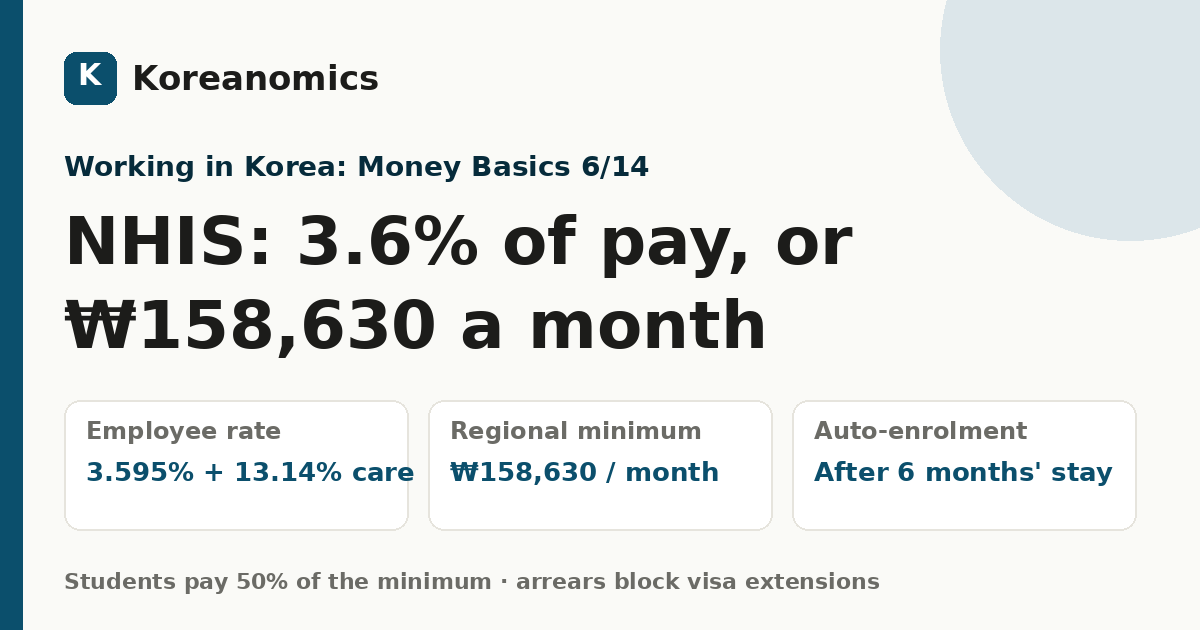
Employee: salary × 3.595% health + 13.14% of that for long-term care; the employer pays the same. Regional (foreigner): the higher of the standard income/property formula and the previous year's average premium — ₩158,630 in 2026 (health ₩140,210 + care ₩18,420). Property points are approximated. Students: 50% of the minimum health premium.
Two kinds of subscriber
Workplace subscribers (직장가입자) are employees. The premium is 7.19% of salary in 2026, split equally: you pay 3.595%, the company pays 3.595%. Long-term care insurance (장기요양보험) is added at 13.14% of the health premium. On ₩4M a month that is ₩143,800 + ₩18,900 = about ₩162,700 from your side. Enrolment is automatic on your first day, whatever the visa, and there is no minimum residence period. Your employer handles everything; your only job is to register dependents.
Regional subscribers (지역가입자) are everyone else: freelancers, business owners, job-seekers between contracts, spouses on F-6 who do not work, students, and retirees. A foreigner becomes a regional subscriber automatically after six months of residence (immediately for F-5, F-6, D-2/D-4 and a few other statuses) — the 2019 reform that ended the days of choosing whether to join. The premium follows the same income-and-property formula as for Koreans, with one difference: it can never be lower than the average premium of all subscribers the previous year, which for 2026 is ₩158,630 a month including long-term care. A Korean with no income and no property might pay ₩20,000; a foreigner in the same position pays ₩158,630. Students on D-2/D-4 get 50% off the health part.
The logic behind the minimum is that foreigners' overseas income and assets are invisible to the NHIS. The effect is that a low-earning foreign freelancer pays proportionally far more than a Korean one; there is no appeal.
Dependents
Employees can register a spouse and children under 19 immediately, and from April 2024 other relatives — parents, parents-in-law, adult children — only after they have lived in Korea six months. Dependents pay nothing and receive the same coverage. Registration is at any NHIS branch with the family relationship document (apostilled or consular-certified, with Korean translation) and their ARC or passport.
Regional subscribers cannot have dependents. A non-working spouse of a regional subscriber is instead billed within the same household premium.
What it covers, and what you pay at the counter
The NHIS pays 50–80% of most treatments. Your co-payment depends on where you go: 30% at a clinic (의원), 40% at a hospital, 50% at a general hospital and 60% at a tertiary university hospital — the system pushes you to start small. Inpatient care is 20%. Prescriptions at the pharmacy are 30%. Dental checks, cleaning and a growing share of fillings are covered; cosmetic procedures, most orthodontics, private rooms and non-listed drugs are not. A free general health check is included every two years (every year for non-office employees).
Two things surprise foreigners. The out-of-pocket ceiling (본인부담상한제) refunds anything you pay above an income-based cap per year (from about ₩900,000 for low earners to ₩8M+); the refund arrives automatically the following August. And private insurance (실손보험) is a separate product sold by insurers, which some employers provide; it reimburses the co-payments, not the premiums.
Arrears and your visa
Since July 2019 Immigration checks your NHIS record at every extension or change of status. Under the current guideline, 1–3 months of unpaid premiums limit the extension to six months at a time; 4 or more months mean the extension is refused until you clear the debt (payment plans are accepted). Unpaid premiums do not disappear when you leave and are billed again if you return. Late fees accrue daily, capped at 9% of the premium in total.
The usual way people fall into arrears without noticing is the gap between jobs: your workplace enrolment ends on the last day of employment, the regional enrolment starts automatically the next day at the ₩158,630 minimum, and the bill goes to a registered address you may have left. Register a phone number or email with the NHIS (1577-1000, press 7 for foreign languages) so the notices reach you.
Leaving Korea
Enrolment ends on your departure date if you leave for good, and premiums paid for later months are refunded to a Korean account (or by the tax-refund window at the airport for small amounts). Regional subscribers away for a month or more can ask for a suspension of those months — but only in advance for pre-planned trips, or after the fact with the immigration record. Employees stay on payroll insurance during business trips or leave. Part 14 has the full leaving checklist.
Employment insurance, the smallest of the four deductions at 0.9%, is the one most foreigners pay for nothing — because they never learn they can claim unemployment benefits. That is next.
Frequently asked questions
I am on a D-2 student visa. Do I have to pay?
Yes, since March 2021 foreign students are enrolled as regional subscribers from their first day, but at a 50% discount on the minimum — about ₩79,000 a month in 2026 (the health portion; long-term care is added). Your university may collect it with tuition. Private insurance does not exempt you.
Can my spouse and children be my dependents?
If you are an employee subscriber, yes: your spouse and children under 19 can be registered immediately; other family members (parents, adult children) must have lived in Korea for 6 months first, under the April 2024 rule. Dependents pay nothing. Regional subscribers cannot register dependents — each family member is billed within one household premium.
What happens if I stop paying?
Benefits are suspended from the next month, and Immigration checks NHIS arrears at visa extension: up to 3 missed months are tolerated with a 6-month extension limit, 4 or more missed months mean the extension is refused until you pay. Arrears also follow you if you return to Korea later.
I leave Korea for two months. Do I keep paying?
A regional subscriber who is abroad for one month or more can have the premium suspended for those months (급여정지) — the NHIS sees the immigration record. Employees keep paying through payroll. If you leave Korea for good, your enrolment ends on the departure date; tell the NHIS or it will keep billing.
Do I get a refund of premiums when I leave Korea?
No — health insurance is pay-as-you-go, not a savings scheme; only a premium already paid for a month after your departure date is refunded. The refund people mean is usually the National Pension one (Part 4).
Sources
- National Health Insurance Service — Foreigners' enrolment (English)
- Ministry of Health and Welfare — 2026 premium rate 7.19%, long-term care 13.14%
- National Health Insurance Act, Art. 109 (foreigners) and Enforcement Rule Art. 61-2 (6-month dependents rule, 2024)
- Ministry of Justice — visa extension restrictions for NHIS arrears (2019 guideline, applied at extension)
※ This guide is general information for foreign residents of Korea, not tax, legal or immigration advice. Rules differ by visa, nationality and tax treaty and change every year; confirm with the National Tax Service (126 → 7), NPS (1355), NHIS (033-811-2000) or Immigration (1345) before acting.