Driving in Korea as a Foreigner (2026): International Permit for 1 Year, Exchanging Your Licence (Which Countries Skip the Test), Fees, Documents, and Renting a Car
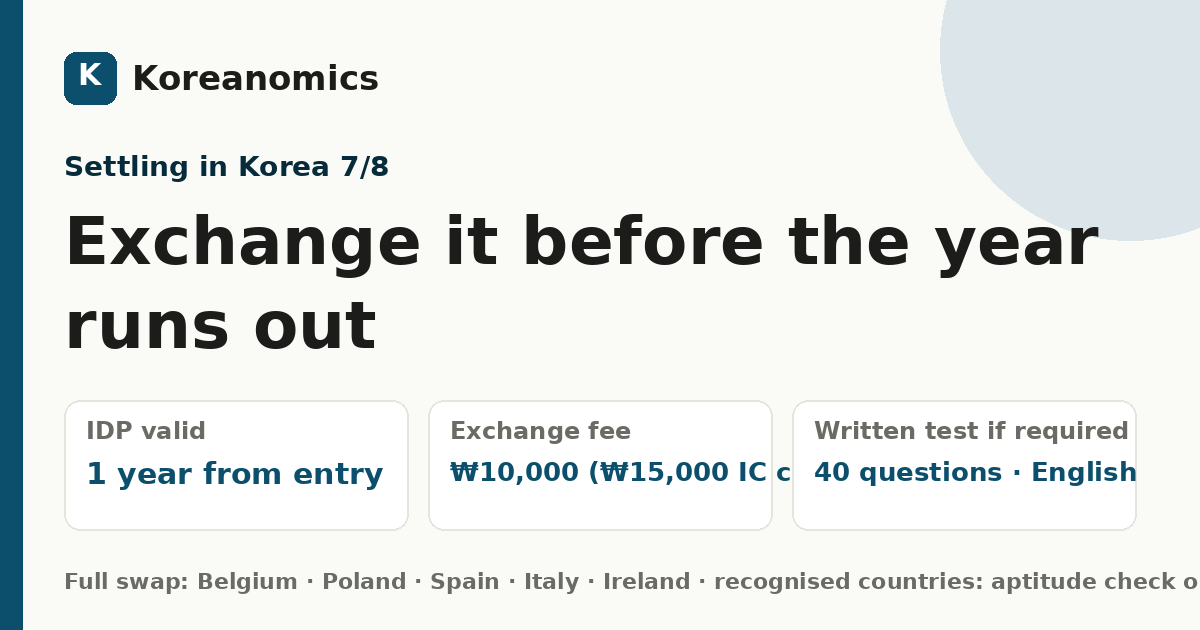
An IDP is valid one year from entry. To exchange: 5 countries swap outright, recognised countries skip the written test, others sit a 40-question exam.
Contents
Korea is a good place to drive — expressways are excellent, navigation apps are precise, and a car changes weekends outside Seoul — and its licence rules for foreigners are generous: a valid foreign licence gets you a Korean one without a road test. The catch is the clock. Your International Driving Permit is good for one year from the day you entered, and the embassy paperwork for the exchange takes weeks. This part sets out who needs what, the fees, the documents, and the rules for renting.
Licence exchange checker (2026)
Recognised-country list is maintained by the Korea Road Traffic Authority (66 countries / 97 jurisdictions; US licences are assessed by state) — check your country on safedriving.or.kr before relying on this. Fees: licence ₩10,000 (standard) / ₩15,000 (mobile IC), aptitude test ≈ ₩8,000, written test ₩10,000. All holders of a valid foreign licence are exempt from the practical (road) test.
Driving on arrival: the one-year rule
A foreign licence by itself is not valid in Korea. What is valid is an International Driving Permit under the 1949 Geneva or 1968 Vienna conventions, carried with the home licence and passport, for 1 year from the date of entry (Road Traffic Act, Art. 96). Leaving and re-entering does not reset the year for residents. Rental companies check all three documents and the entry stamp; after the year, or without the IDP, you are an unlicensed driver — a criminal matter, with the rental insurance void. Residents should treat the IDP as a bridge to the exchange, not a licence.
Exchanging your licence
Korea issues a Korean licence to holders of a valid full foreign licence without a road test. Which other test you take depends on the issuing country:
- Full reciprocity (no test): Belgium, Poland, Spain, Italy, Ireland.
- Recognised countries and regions — 66 countries and 97 jurisdictions on the Road Traffic Authority's list, which includes most of the EU, the UK, Japan, Australia, New Zealand, Canada, Singapore, and US licences assessed state by state (most states are recognised; a few are not): aptitude test only — eyesight, hearing, reflexes, about fifteen minutes.
- Not on the list: written test (40 multiple-choice questions on Korean traffic law and signs, 60% to pass, in English, Chinese, Vietnamese, Russian and other languages) plus the aptitude test. The test is not hard; the Authority's English study app (Safe Driving) has the question bank.
Documents, at any of the 27 licence examination offices (운전면허시험장; Gangnam, Gangseo, Dobong and Seobu in Seoul, Nambu in Busan): the original licence (full, not provisional, and valid), passport showing at least 90 days' residence in the issuing country, Residence Card, three 3.5 × 4.5 cm photos taken within six months, an immigration entry/exit record (출입국사실증명서, free on gov.kr), and the item that takes time — proof of authenticity: an apostille on the licence or a certified copy from the issuing authority, or a confirmation letter from your embassy in Korea, dated within the last year. Embassies differ (the US embassy notarises a statement; the UK's DVLA and Australian state authorities issue letters), so start there.
Fees: ₩10,000 for the standard bilingual licence or ₩15,000 for the mobile IC-card version, plus about ₩8,000 for the aptitude test and ₩10,000 for the written test where required. Issue is same-day. The office keeps your foreign licence and returns it when you leave Korea permanently — ask for a certified copy first if you need it for insurance at home.
The Korean licence (class 2 ordinary, 2종 보통, for cars; class 1 for larger vehicles and most rental vans) is valid ten years and is itself widely exchangeable when you move on. A Korean IDP costs ₩8,500 at any licence office or the Incheon Airport counter.
Renting and owning a car
Rental companies (Lotte, SK, and the Socar/Green Car sharing apps for residents) accept a Korean licence, or a foreign licence with IDP within the one-year window, plus a credit card; drivers under 26 or licensed under a year pay surcharges or are refused. Insurance is where the money is: the standard cover has a high excess, and the "full coverage" (완전자차) option that reduces it to zero or a small amount is worth its ₩15,000–30,000 a day. Expressway tolls are paid by Hi-Pass transponder (rentals include one, billed afterwards) or cash/card at the booth; fuel is about ₩1,600–1,800 a litre in 2026.
Owning a car as a resident is straightforward — registration at the district office with the Residence Card, mandatory liability insurance, and the annual car tax that our Korean sister site calculates. Parking is the constraint in Seoul; in Busan and the regions it is the reason to have a car.
Rules that catch foreigners
Speed cameras are everywhere and fines arrive by post to your registered address (another reason for Part 1's 15-day rule); the drink-driving limit is 0.03% BAC — one drink — with licence suspension at the first offence; right turns on red are allowed only after a full stop and when the pedestrian signal is not green, a rule tightened in 2023; school zones are 30 km/h with cameras; and in an accident you must stop and exchange details, with 112 for police and 119 for injuries.
The last part of the course puts a number on all of this: what a month in Seoul, Busan or a regional city actually costs a single foreigner in 2026.
Frequently asked questions
Can I just keep driving on my International Driving Permit?
For one year from your entry date, yes, together with your home licence and passport. After that it is driving without a licence — a criminal offence, and your insurance is void. Residents should exchange within the year; the exchange itself takes a morning once the documents are ready, so the deadline is only a problem if you leave the embassy step to the last month.
Do I have to take a test?
Depends on the country that issued your licence. Five countries (Belgium, Poland, Spain, Italy, Ireland) have full reciprocity — no test. 'Recognised' countries and regions — most of Europe, Japan, Australia, Canada, and US licences state by state (66 countries, 97 jurisdictions on the current list) — skip the written test and take only the aptitude check (eyesight, reflexes). Everyone else sits the 40-question written test, offered in English, Chinese, Vietnamese and other languages, at the licence examination office; the practical test is waived for all holders of a valid foreign licence.
What is the embassy document everyone mentions?
Proof that your licence is genuine: either an apostille from your home country on the licence (or a certified copy) or a confirmation letter from your embassy in Seoul, issued within the last year. Which one depends on the embassy — the US embassy issues a notarised statement, the UK requires the DVLA check-code approach, Australia the state authority's letter. Start this first; it is the slow step.
Will my Korean licence work abroad, and can I get my home licence back?
Korea keeps your foreign licence when it issues the Korean one and returns it when you leave the country for good (or exchange back). A Korean licence is accepted in most countries with a Korean IDP (issued at any licence office or Incheon Airport, ₩8,500), and Korea has reciprocal exchange with many countries for when you move on.
Sources
※ This article summarises publicly available rules as of the date shown. Your situation may differ; confirm with the relevant Korean authority (National Tax Service, Ministry of Employment and Labor, National Pension Service, Immigration) or a licensed professional before making decisions.