Getting a Korean Phone Number as a Foreigner (2026): Prepaid vs Postpaid vs MVNO, the Face-Verification Rule, eSIM, and Why the Number Matters More Than the Plan
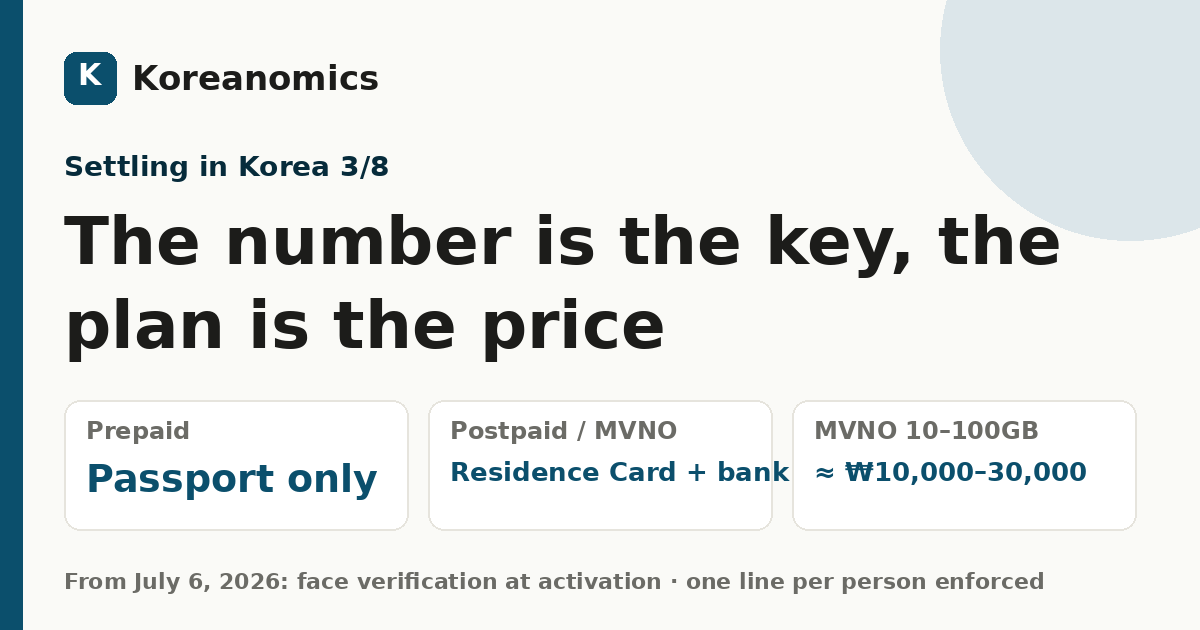
A Korean number in your name unlocks bank apps and identity checks. Prepaid needs a passport; postpaid a Residence Card; MVNO plans ₩10,000–30,000 a month.
Contents
Korea has some of the cheapest good mobile data in the world and one of the strictest identity systems attached to it. The plan is a detail; the number registered to your Residence Card is what you are really buying, because it is the key to your bank app, to Toss and Kakao, to hospital bookings and to every "본인인증" pop-up you will meet. This part explains the three kinds of line, what each needs, what changed in July 2026, and how much a sensible plan costs.
Two-year phone cost comparison (2026)
Typical 2026 prices: MVNO 10GB ≈ ₩10,000, 30GB ≈ ₩15,000, 100GB ≈ ₩25,000, unlimited ≈ ₩35,000; carrier (SKT/KT/LG U+) 10GB ≈ ₩45,000, 100GB ≈ ₩69,000, unlimited 5G ≈ ₩85,000 before family/bundle discounts. Carrier contracts often bundle a 25% "선택약정" discount for 24 months or a device subsidy — enter the net price you were quoted. Prepaid tourist SIM: ≈ ₩30,000–40,000 per 30 days, unlimited data.
Three kinds of line
| Prepaid (선불) | Postpaid carrier (후불) | MVNO / 알뜰폰 | |
|---|---|---|---|
| Who | Tourists, first weeks | Residents wanting a shop and a bundle | Residents who want the price |
| ID needed | Passport | Residence Card + Korean bank account or card | Residence Card + Korean bank account (online verification) |
| Where | Airport kiosks, convenience stores, carrier shops | Carrier shops (SKT, KT, LG U+) | Online (each MVNO's site or the government's 알뜰폰 허브), a few kiosks |
| Typical cost | ₩30,000–40,000 / 30 days | ₩45,000–90,000 / month | ₩10,000–30,000 / month |
| Identity verification (본인인증) | Usually not accepted | Yes | Yes |
| Contract | None | Often 24 months for discount/device | None or short |
The column that matters is the last-but-one. A prepaid tourist SIM gets you data and a number, but most services will not treat it as your number for verification, and it expires. A postpaid or MVNO line in your name, on your Residence Card, is the one you keep.
The order of operations
- Residence Card (Part 1) — needed for any non-prepaid line.
- Bank account (Part 2) — the line's autopay; the bank app itself needs the phone, so open the account with a passbook first.
- Phone line — carrier shop with card and bank details, or MVNO online.
- Back to the bank to register the Korean number for the app, then Toss, Kakao, Coupang, hospital apps.
Until step 3 you can run on a prepaid SIM or roaming; many people keep the prepaid number for a month while the Residence Card is being made, then port or drop it.
What changed in 2026: face verification
From July 6, 2026, every new activation — carrier or MVNO, prepaid or postpaid, in shop, online or by phone — requires face verification against the ID presented, a nationwide measure against "burner" phones used in voice-phishing. For foreigners the shop scans the Residence Card (or passport for prepaid) and your face; online sign-ups use the app camera. The ministry also announced stricter checks on foreigners' ID documents with the Ministry of Justice and firm enforcement of one line per person for prepaid. The practical effects: bring the physical card (or the mobile ID), expect an extra minute, and do not expect a friend to "lend" a line.
Choosing a plan
Most residents overbuy. Maps, messaging, music and an hour of video a day fit inside 30GB; the "unlimited" plans are for hotspot users and heavy streamers. Carrier plans start around ₩45,000 and reach ₩85,000–90,000 for unlimited 5G, before the 25% contract discount (선택약정) or a device subsidy; MVNOs sell the same network at ₩10,000 for 10GB, ₩20,000–30,000 for 100GB, and run new-subscriber promotions below that. The carrier premium buys shops (with English staff in Itaewon and the big malls), device financing, family and home-internet bundles, and simpler roaming. If you brought an unlocked phone and can handle a Korean web form (browser translation is enough), an MVNO is the rational choice; the calculator above shows a two-year gap that is usually over ₩1,000,000.
Devices, eSIM and porting
Bring an unlocked phone that supports Korean LTE (bands 3/7/8) and 5G (n78) — every recent iPhone, Galaxy and Pixel does. eSIM is offered by the carriers and most MVNOs; tourist eSIMs at the airport are fine for the first weeks. Buying a phone in Korea on a carrier instalment plan is common and requires the same documents as the line plus a credit check; Samsung's own stores sell unlocked at list price. Porting a number between providers (번호이동) takes an hour online and is how MVNO promotions are usually claimed.
Two things to set up on day one
Emergency and hotline numbers: 119 (fire and ambulance), 112 (police), 1345 (immigration contact centre, multilingual), 1330 (Korea travel hotline, 24 hours, English/Chinese/Japanese and more, also works as a general interpreter line), 120 (Seoul's Dasan call centre, English available). The old 1339 medical hotline no longer exists as a separate number — call 119.
Emergency alerts: Korean phones receive government disaster texts (재난문자) automatically; foreign phones do not unless you install the Emergency Ready app (English). With a Korean line you will start receiving them, mostly heat, cold and heavy-rain warnings — the next part explains what to do when one of them sends you to a hospital.
Frequently asked questions
Why do I need a Korean number if I have roaming?
Because identity in Korea runs through the phone. Bank apps, Toss, Coupang, Kakao services, government sites, hospital bookings and even some delivery apps verify you by sending a code to a number registered to your Residence Card. A foreign number cannot be registered, and a prepaid tourist SIM in your passport name often cannot either. A postpaid or MVNO line in your own name, tied to your card, is what makes everything else work.
What changed on July 6, 2026?
New activations at all three carriers and every MVNO, prepaid or postpaid, require face verification against your ID document — a measure against 'burner' phones used in voice-phishing. For foreigners this means the shop scans your Residence Card or passport and your face; the government also announced tighter checks on the authenticity of foreigners' ID documents and strict one-person-one-line enforcement. Expect activation to take a few minutes longer and to require you in person or through the carrier's app camera.
Is an MVNO (알뜰폰) really the same network?
Yes. Alddeulphone providers rent capacity on SKT, KT or LG U+ and sell it without the retail overhead — same coverage, same 5G/LTE, no shops. A 10GB plan runs about ₩10,000 a month, 100GB about ₩20,000–30,000, and promotions for new subscribers go far lower. The trade-offs: sign-up is online (you need a Korean bank account and a Residence Card that the site's verification accepts), customer service is by chat, and roaming abroad is patchier.
Can I use eSIM?
Most MVNOs and the carriers issue eSIMs for compatible unlocked phones; airport kiosks sell tourist eSIMs. Check your phone is carrier-unlocked (phones bought on contract abroad often are not) and supports Korean 5G bands (n78) or at least LTE band 3/7/8 — nearly all recent iPhones and Samsung and Pixel models do.
Sources
※ This article summarises publicly available rules as of the date shown. Your situation may differ; confirm with the relevant Korean authority (National Tax Service, Ministry of Employment and Labor, National Pension Service, Immigration) or a licensed professional before making decisions.