Korean Salary Explained: Take-Home Pay Calculator for Foreigners (2026) — the 4 Insurances, Income Tax, Flat 19% Option
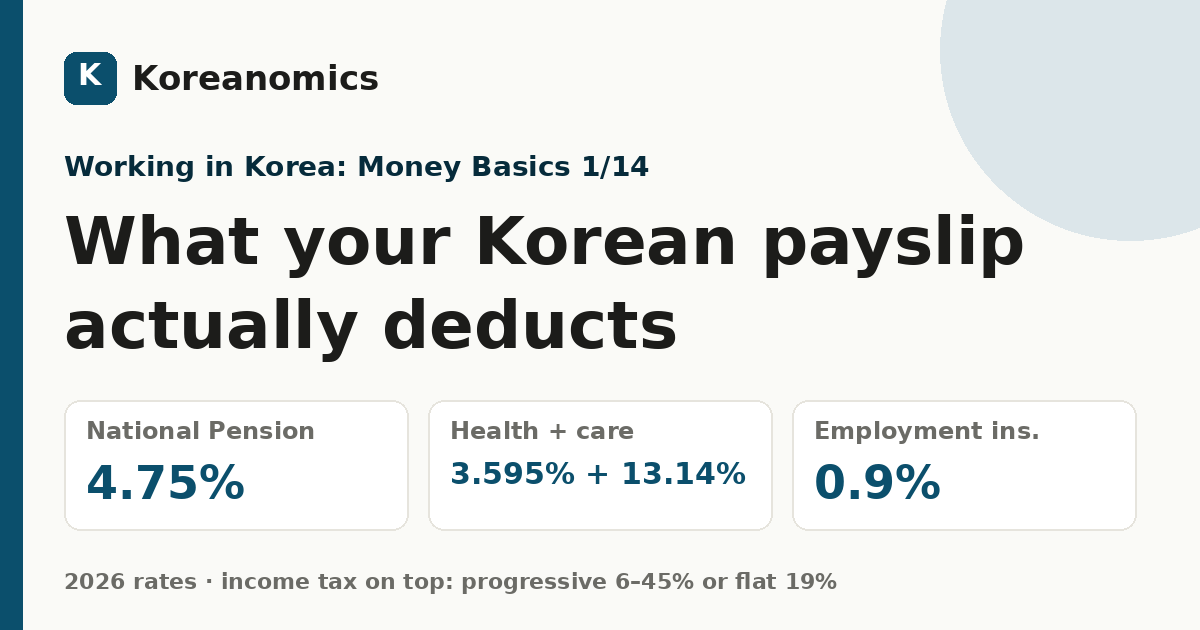
Korean payslip deductions in 2026: pension 4.75%, health 3.595%, employment 0.9%, income tax (progressive or the foreigner 19% flat rate). Net-pay calculator.
Contents
A Korean job offer says ₩50,000,000. Your first payslip says something closer to ₩3,550,000 for the month, and it is split into a dozen Korean line items. This first part of the course explains every one of them and gives you a calculator that uses the same 2026 rate tables as our Korean-language sister site, with the one thing Korean calculators leave out: the 19% flat-rate option that only foreigners can elect.
Take-home pay calculator (2026)
Annual figures divided by 12. Progressive tax uses the earned-income deduction, basic deduction (₩1.5M per person), pension premium deduction, earned-income tax credit and the ₩130,000 standard credit — i.e. what you get with no extra receipts. Real withholding differs month to month; the year-end settlement trues it up. Flat rate applies to gross pay including non-taxable allowances and forfeits all deductions.
The four insurances (사대보험)
Every Korean payslip has four social insurance lines. Three come out of your pay; the fourth, industrial accident insurance, is paid entirely by the employer.
| Deduction | Employee share (2026) | Employer share | Who is enrolled |
|---|---|---|---|
| National Pension (국민연금) | 4.75% of pay up to ₩6,590,000/month | 4.75% | Workplace employees 18–59, most nationalities. Excluded: D-2/D-4 students, trainees, nationals of countries that do not cover Koreans (e.g. Vietnam, Nepal, Pakistan, Singapore) |
| Health insurance (건강보험) | 3.595% | 3.595% | All employees regardless of visa |
| Long-term care (장기요양) | 13.14% of the health premium (≈0.47% of pay) | same | Rides on health insurance |
| Employment insurance (고용보험) | 0.9% | 0.9% + 0.25–0.85% | Mandatory for F-2, F-5, F-6 (and D-7/8/9 by reciprocity); voluntary for E-1 to E-7 and F-4; E-9/H-2 must join the job-security part but the unemployment-benefit part is optional |
| Industrial accident (산재보험) | 0% | 0.7–18% by industry | Everyone, any visa |
Together the employee side is about 9.7% of pay in 2026 (up from 9.2% because the pension rate rose from 9% to 9.5%; it rises 0.5 points a year until it reaches 13% in 2033). The employer pays roughly the same again, which is why Korean HR talks about "total labour cost" being 10% above your salary.
Two foreigner-specific points. If your nationality is on the pension exclusion list you simply won't see the pension line, and you also won't get a refund when you leave, because nothing was paid in — Part 4 has the country lists. And if you are on an E-7 and your payslip shows no employment insurance, that is normal: you are not covered unless you or your employer applied, which also means no unemployment benefit if you lose the job (Part 7).
Income tax — two systems, you choose
Korea taxes residents (183+ days a year) on a progressive scale from 6% to 45%, plus a local income tax of 10% of the national tax. Before the rate is applied, three big deductions shrink the taxable amount: an earned-income deduction (70% of the first ₩5M, then 40%, 15%, 5%, 2% by band, capped at ₩20M), a basic deduction of ₩1.5M for you and each dependent, and your pension premiums. After the rate is applied, an earned-income tax credit knocks off 55% of the first ₩1.3M of tax and 30% of the rest, capped by salary band. The result is that a ₩50M salary pays only about 6% effective income tax (≈₩3M including local tax), and ₩100M about 13%.
Foreign workers can instead elect a flat 19% (20.9% with local tax) on gross pay for up to 20 years from their first day of work in Korea. No deductions, no credits, and it applies to all pay including the tax-free meal allowance. It is only worth it above roughly ₩160M — and from 2027 the government proposes to raise it to 21%. Part 2 works through the break-even.
What your employer deducts each month is not the real tax but a table-based estimate. The real number is settled once a year (Part 3).
Reading the Korean payslip
| Korean | Meaning |
|---|---|
| 기본급 | Base salary |
| 식대 | Meal allowance (₩200,000/month non-taxable) |
| 연장근로수당 / 야간 / 휴일 | Overtime (×1.5), night (+50%), holiday pay |
| 상여금 | Bonus |
| 국민연금 / 건강보험 / 장기요양 / 고용보험 | The four insurance deductions |
| 소득세 / 지방소득세 | National income tax / local income tax (10% of it) |
| 공제합계 | Total deductions |
| 실수령액 (차인지급액) | Net pay |
Two numbers are worth checking on every payslip. The health insurance line should be 3.595% of your taxable pay; if it is far higher you may have been enrolled as a regional (self-employed) subscriber by mistake. And overtime should appear separately: Korean law pays 1.5× for hours beyond 40 a week at workplaces with five or more employees, and a "comprehensive salary" (포괄임금) contract must still state how many overtime hours the salary covers.
Quick reference: what net pay looks like in 2026
| Gross / year | Insurances (employee) | Income tax (progressive) | Net / month | Net as % |
|---|---|---|---|---|
| ₩30,000,000 | ₩2.68M | ≈ ₩0.38M | ≈ ₩2.25M | 90% |
| ₩50,000,000 | ₩4.63M | ≈ ₩2.98M | ≈ ₩3.53M | 85% |
| ₩80,000,000 | ₩7.54M | ≈ ₩8.49M | ≈ ₩5.33M | 80% |
| ₩120,000,000 | ₩9.60M | ≈ ₩19.8M | ≈ ₩7.55M | 76% |
| ₩160,000,000 | ₩11.6M | ≈ ₩35.2M (flat: ₩33.4M) | ≈ ₩9.44M | 71% |
Single, no dependents, pension enrolled, ₩200,000 meal allowance, employment insurance included. Use the calculator for your own visa combination.
Next: the one tax decision that is yours alone to make — the 19% flat rate.
Frequently asked questions
Why is my first payslip lower than the salary in my contract?
Korean contracts quote gross pay. Four social insurance deductions (roughly 9.7% of salary in 2026) and withheld income tax come out before you are paid. For a ₩50M salary the typical net is about ₩42–43M a year under the progressive tax, i.e. roughly 84–86% of gross. Your employer pays a similar amount again on top for its share of the insurances.
Do foreigners pay the same deductions as Koreans?
Mostly yes. National Pension is mandatory for workplace employees of most nationalities (some countries are exempt by reciprocity, and D-2/D-4 students are excluded); health insurance is mandatory for all employees; employment insurance depends on visa (mandatory for F-2/F-5/F-6, voluntary for E-7 and most E visas, and the unemployment part is optional for E-9/H-2). Income tax is the one place foreigners get a special choice: the 19% flat rate.
What is the difference between 'withholding' and my real tax?
Each month your employer withholds an estimate from a government table (간이세액표). The real tax is calculated once a year in the year-end settlement (연말정산) in January–February, and the difference is refunded or collected with your February or March pay. Part 3 of this course covers it.
Is the ₩200,000 meal allowance taxed?
Not under the progressive system — up to ₩200,000 a month of meal allowance (and ₩200,000 childcare allowance per child under 6) is non-taxable. But if you elect the 19% flat rate, the flat rate applies to your entire pay including non-taxable allowances. That is one of the reasons the flat rate is only worth it at high salaries.
Sources
- PwC Worldwide Tax Summaries — Korea, individual income determination and rates
- National Pension Service — 2026 contribution rate and standard monthly income cap
- Ministry of Health and Welfare — 2026 health insurance rate 7.19%
- Enforcement Decree of the Employment Insurance Act, Art. 3-3 (coverage of foreign workers)
- Restriction of Special Taxation Act, Art. 18-2 (19% flat rate for foreign workers)
※ This guide is general information for foreign residents of Korea, not tax, legal or immigration advice. Rules differ by visa, nationality and tax treaty and change every year; confirm with the National Tax Service (126 → 7), NPS (1355), NHIS (033-811-2000) or Immigration (1345) before acting.