E-7 Visa Korea 2026: Minimum Salary Thresholds (₩31.12M / ₩25.89M / ₩26M), Qualification Rules, Employer Quotas, and the E-7-4 Skilled Worker Route
Korea's E-7 work visa in 2026: salary floors by subcategory (₩31.12M / ₩25.89M / ₩26M), degree rules, the 20% employer ratio, E-7-4 points. Threshold checker.
Contents
The E-7 (특정활동, "specific activities") is the visa most foreign professionals in Korea hold: engineers, developers, designers, chefs, marketers, teachers outside the E-2 system, and — through the E-7-4 route — factory and farm workers who have graduated from E-9. It is employer-sponsored, tied to one of 94 occupation codes, and gated by a minimum annual salary that the Ministry of Justice resets every year. For 2026 those floors are the numbers below; an offer under them is refused before anything else is looked at.
E-7 salary threshold checker (2026)
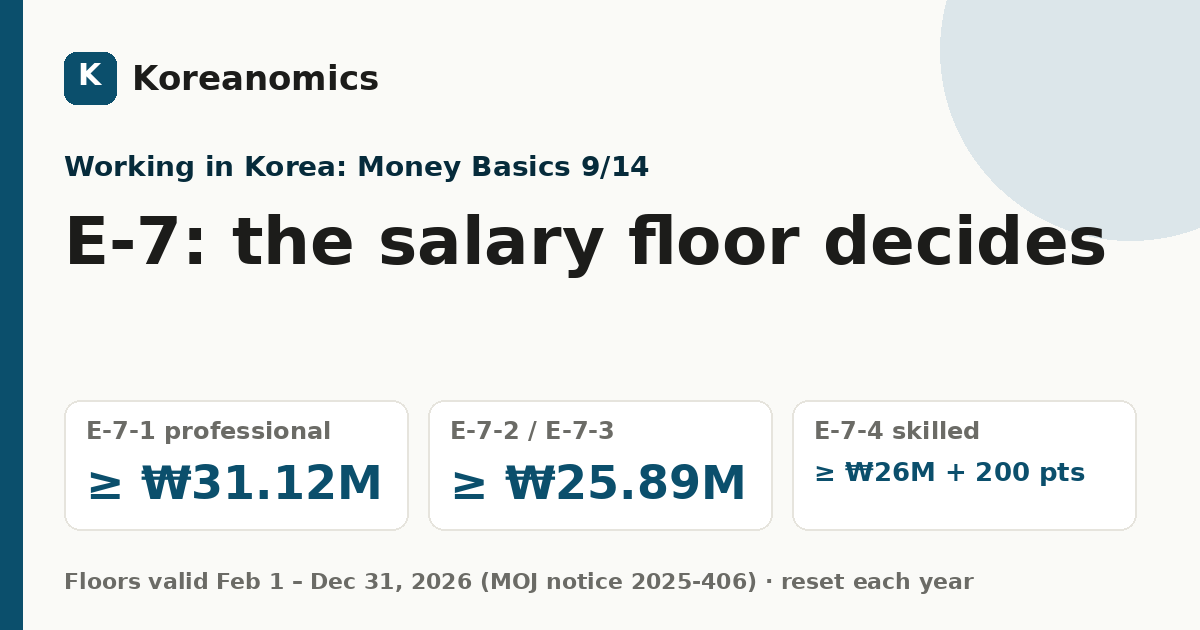
Floors from MOJ notice 2025-406, valid February 1 – December 31, 2026. Reduced floors exist for some Korean-university graduates, regional companies and specific occupations — treat this as the standard case. Employer ratio: general 20% of Korean full-time staff (30% for root industries and E-7-4); firms with under 5 Korean employees usually limited to one E-7.
The four subcategories and their 2026 floors
| Subcategory | Who | 2026 minimum annual pay | Monthly |
|---|---|---|---|
| E-7-1 Professional | Managers and specialists — 67 occupation codes including software developers, engineers, designers, researchers, marketing and finance specialists, foreign-language instructors outside E-2 | ₩31,120,000 | ≈ ₩2.59M |
| E-7-2 Semi-professional | Technicians and service jobs — hotel front desk, flight attendants, interpreters, tour guides, some IT support | ₩25,890,000 | ≈ ₩2.16M |
| E-7-3 General skilled | Trades — welders, shipbuilding fitters and painters, aircraft mechanics, some chefs | ₩25,890,000 | ≈ ₩2.16M |
| E-7-4 Skilled worker | Ex-E-9/E-10/H-2 workers who pass the points test | ₩26,000,000 | ≈ ₩2.17M |
The E-7-2/3 floor equals the 2026 minimum wage for 209 hours (₩2,156,880 × 12); the E-7-1 floor is roughly 60% of 2025 per-capita GNI. The Ministry publishes a new notice each January; the 2027 floors will rise at least with the minimum wage (₩10,700/h → ₩26.84M).
"Annual pay" for this purpose is the guaranteed amount in the contract: base salary plus fixed allowances and any bonus that is not discretionary. Overtime and performance bonuses do not count. Immigration checks the contract at issuance and the actual payslips at extension — an E-7 holder whose real pay fell below the floor for the year is refused an extension.
Qualifying as a person
For E-7-1 and most E-7-2/3 codes you need one of: a master's degree or higher in the field; a bachelor's degree plus one year of relevant experience (the year is waived for graduates of Korean universities and for some in-demand codes); or five years of relevant experience without a degree. Chefs need a certificate and experience; some codes have their own rules. Documents from abroad must be apostilled or consular-certified with Korean translations; degree verification is strict, and a criminal record check and a health certificate (tuberculosis) are standard.
Graduates of Korean universities (D-2 → E-7) get the widest exceptions: any field-related job code, reduced salary floors in some cases, and, since 2024–2025, additional routes for STEM and regional-university graduates (regional-specialisation visas, the top-talent K-Tech Pass track).
Qualifying as an employer
The employer must be a registered business, up to date on wages and social insurance, and within its foreign-hire ratio — 20% of Korean full-time employees for most industries, 30% for the six "root industries" (casting, moulds, welding, plastics, surface treatment, heat treatment) and for E-7-4 hires, with regional exceptions announced yearly. Companies that dismissed Korean staff in the previous three months, or that have wage arrears, are refused. A company with fewer than five Korean employees is usually limited to one E-7.
This ratio is why small start-ups sometimes cannot hire you even at a compliant salary, and why offers say "subject to visa" — the employer's own eligibility is checked at the same time as yours.
E-7-4: from E-9 to a long-term visa
The E-7-4 skilled worker route lets a non-professional worker with four or more years on E-9, E-10 or H-2 convert to an E-7, which unlike E-9 is renewable indefinitely and leads to F-2 and F-5. The test is a points card (K-point E74): 200 of 300 points, from Korean-language level (TOPIK or KIIP), income, age, years in Korea, employer recommendation, and bonuses for regional and root-industry work. The salary floor is ₩26,000,000, the employer must recommend you, and a clean record (no immigration or tax violations, NHIS arrears paid) is required. Quotas are set annually; the 2026 allocation is in the low tens of thousands. Family can join on F-3 once you hold the E-7-4.
Changing jobs, and what E-7 does not cover
An E-7 is tied to one workplace. To move, obtain a change of workplace permit before the first day at the new employer — the new job must be in the same or an approved code and meet the same floor and ratio. Freelance or side work outside the sponsored job is not allowed without a separate permit. If the job ends, report within 15 days and switch to a D-10 job-seeker visa (Part 12) to stay and look for the next one.
The E-9 system, with its fixed quotas, sending countries and 4-year-10-month clock, works very differently — and its pay rules are the subject of the next part.
Frequently asked questions
Is the E-7 salary rule '80% of GNI'?
Not any more. The Ministry of Justice now publishes fixed won amounts each year by subcategory (notice 2025-406 for 2026). The E-7-1 figure of ₩31.12M is close to 60% of 2025 per-capita GNI (₩52.4M), but it is set by notice, not formula. Older blogs quoting 80% of GNI (₩40M+) are out of date.
My offer is ₩30M for a developer job. Will the visa be refused?
For E-7-1 (which covers most professional jobs including software developers, code 2223 etc.) the 2026 floor is ₩31,120,000 in total annual pay, so ₩30M fails. Employers can include fixed allowances and guaranteed bonuses in the figure if they are in the contract. Certain graduates of Korean universities and some regional/small-firm cases get a reduced floor (typically 70–80% of the standard) — ask the employer's immigration adviser.
How many foreigners can a company sponsor?
As a general rule, E-7 hires are capped at 20% of the number of Korean full-time employees (30% in some root industries and for E-7-4). Companies with fewer than 5 Korean employees are usually limited to one. Companies with unpaid wages, or that laid off Korean staff in the last 3 months, are refused.
Can I change employers on an E-7?
Yes, with prior permission from Immigration (근무처 변경허가) before starting the new job, and the new employer must meet the same salary and quota rules. Changing without permission is a violation that can end your stay. If you are between jobs, apply for a D-10 (Part 12) within the grace period.
Sources
※ This guide is general information for foreign residents of Korea, not tax, legal or immigration advice. Rules differ by visa, nationality and tax treaty and change every year; confirm with the National Tax Service (126 → 7), NPS (1355), NHIS (033-811-2000) or Immigration (1345) before acting.