National Pension Refund for Foreigners Leaving Korea (2026): Who Qualifies by Nationality, How Much You Get Back, How to Claim
Korea refunds National Pension (yours + employer's, 9.5% in 2026) to 24 agreement countries, 26 reciprocity countries and E-8/E-9/H-2 visas. Checker inside.
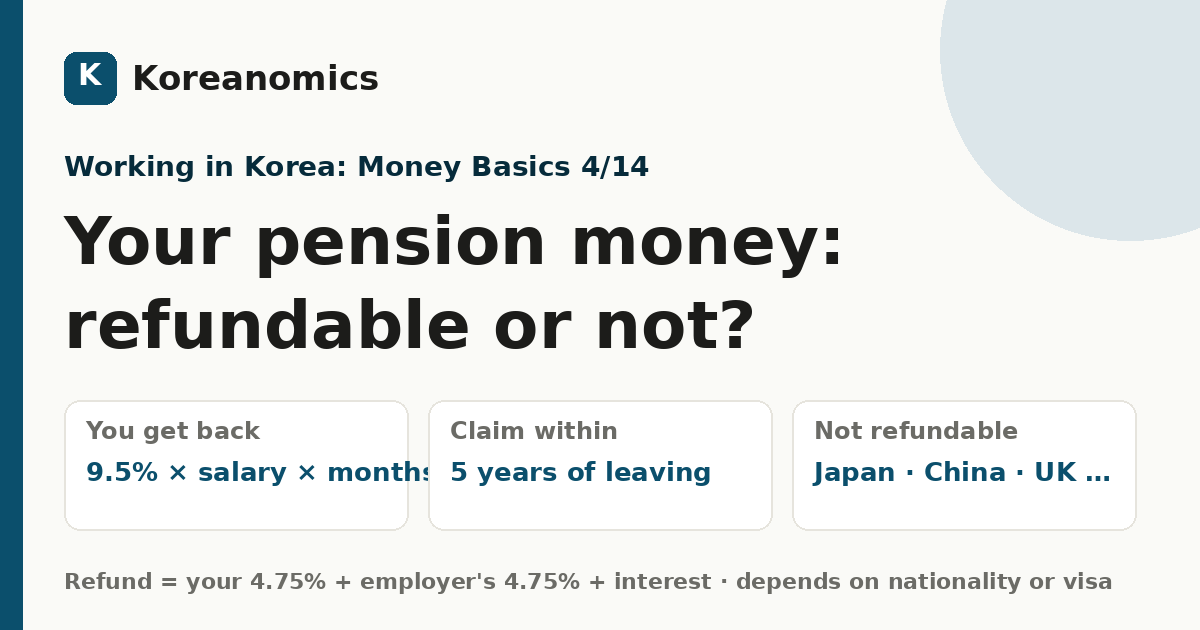
Every month 4.75% of your salary disappears into 국민연금, the National Pension, and your employer sends the same again. Over a three-year contract on a ₩50M salary that is roughly ₩14M sitting in a fund most foreigners will never draw a pension from. Whether you get it back when you leave depends on two things — your nationality and your visa — and the English information on this is wrong more often than right. The checker below encodes the NPS's own country lists; the estimator shows the size of the refund.
Pension refund eligibility checker + amount estimator (2026)
Contribution rate 9% through 2025, 9.5% in 2026, rising 0.5%p each year to 13% in 2033. Salary is capped at the standard monthly income ceiling (₩6,590,000 from July 2026, ₩6.37M the year before, lower earlier). Interest is approximated on the average balance. Retirement-income tax on the employer portion is not deducted here.
Three doors to a refund
Under Article 126 of the National Pension Act, a foreigner who leaves Korea without qualifying for an old-age pension (which takes 10 years of contributions) can receive a lump-sum refund (반환일시금) in exactly three situations:
- Social security agreement with a refund clause — 24 countries as of September 2026, including the United States, Canada, Germany, France, Australia, India, the Philippines, Brazil, Switzerland, Poland and Argentina.
- Reciprocity — your country refunds Koreans, so Korea refunds you. 26 countries: Indonesia, Malaysia, Kazakhstan, Hong Kong, Cambodia and others immediately; Thailand, Laos, Jordan, Zimbabwe and a few more only after 12 months of contributions; Belize after 6 months.
- Visa — E-8 (seasonal), E-9 (EPS) and H-2 (working visit) holders are refunded regardless of nationality. This is why a Vietnamese or Nepali factory worker on E-9 gets a refund while a Vietnamese engineer on E-7 is not even enrolled.
The countries that do not qualify surprise people most: Japan, China, the United Kingdom, Italy, the Netherlands, Ireland, Spain, Sweden, Denmark, Finland, New Zealand, Mongolia, Uzbekistan, Chile and Iran all have agreements with Korea — but they are contribution-exemption or totalization agreements. Your Korean months are credited toward pension eligibility at home; nothing is paid out. And nationals of countries with no agreement and no reciprocity (much of Africa and the Middle East, Russia, most of Latin America outside Brazil, Peru, Uruguay, Argentina, Colombia and El Salvador) simply do not get a refund.
A third group — Vietnam, Myanmar, Bangladesh, Nepal, Pakistan, Saudi Arabia, Singapore, South Africa and a dozen others — are excluded from enrolment altogether because their systems do not cover Koreans. No deduction, no refund, except again on E-8/E-9/H-2 visas. The NPS updates these lists; check the English page linked in the sources before you rely on the checker.
How much comes back
The refund is the entire contribution — your 4.75% plus the employer's 4.75%, i.e. 9.5% of your capped monthly income in 2026 (9% for months up to 2025, and rising half a point a year until 13% in 2033) — plus interest at the 3-year time-deposit rate of Korean banks. On a ₩4.2M salary, three years of contributions is roughly ₩14M before interest.
Two deductions apply. The refund counts as retirement income, so retirement-income tax is withheld on the employer-paid portion accrued since 2002; for a few years of contributions this is small (typically low single-digit percent of the total). And if you owe the NPS anything — unpaid months from a period of self-employment, for instance — it is netted off.
How and when to claim
| Route | When | What you need |
|---|---|---|
| NPS branch in Korea | Within one month before departure | Passport, ARC, flight e-ticket, bank account details (Korean or foreign — payment is released once your departure is confirmed) |
| Incheon Airport NPS counter | On departure day | Same; pays in 16 currencies to your foreign account |
| From abroad | Within 5 years of leaving | Application form, passport copy, proof of departure, foreign bank account certificate — by post or through a representative in Korea with power of attorney |
Payment is made after the NPS confirms you have left Korea (it checks immigration records), usually within a few weeks. If you leave without claiming, the five-year clock starts on your departure date; after that the right lapses.
If you plan to return to Korea to work again, think before claiming: refunded months are erased. Someone who spends 6 years here, leaves, and comes back for 5 more would have crossed the 10-year line for an old-age pension — which, for a ₩5M earner, pays several hundred thousand won a month for life, indexed to inflation — and can only restore the erased years by repaying the refund with interest.
If you are not eligible
Your contributions are not confiscated. Three things can happen to them:
- Totalization: if your country has an agreement (Japan, UK, China and the others listed above), request an insurance-period certificate (가입기간 확인서) from the NPS. Your home pension authority adds those months when deciding whether you qualify for a pension there.
- Korean old-age pension at 10 years: if you reach 120 months of contributions — including through later stints in Korea — you receive a Korean pension from age 63 (65 from 2033) wherever you live. The NPS pays abroad.
- Future agreements: Korea signs new agreements regularly; several of the "no refund" countries have been in negotiation to add refund clauses. A claim becomes possible if the rules change within the 5-year window.
And for the excluded nationalities, the practical advice is the reverse: check your payslip. If 국민연금 is being deducted and you are not on E-8/E-9/H-2, your employer has enrolled you by mistake and the money should be returned as an erroneous payment.
Severance pay — the other lump sum that arrives when a job ends — is not a pension matter at all, and unlike the refund, every foreign employee is entitled to it. That is the next part.
Frequently asked questions
I am British/Japanese/Chinese. Why can't I get my pension back?
The UK, Japan and China have social security agreements with Korea, but they are 'contribution exemption' or 'totalization' agreements, not refund agreements. Your Korean months are added to your home-country record for pension eligibility instead of being paid out. The only exception is visa-based: E-8, E-9 and H-2 holders get a refund regardless of nationality.
Does the refund include my employer's half?
Yes. The lump-sum refund pays back the full contribution — your 4.75% and the employer's 4.75% (2026 rates) — plus interest at the 3-year time-deposit rate. A small retirement-income tax is withheld on the employer-paid portion accrued since 2002.
Can I claim before I leave?
You apply at an NPS branch within one month before departure with proof of your flight (or at the Incheon Airport NPS counter on the day you fly), and the money is transferred to your foreign bank account after you have left. If you have already gone, apply from abroad by mail or through a Korean-based representative, within five years of leaving.
I heard the rules changed in September 2026 and refunds are being cut.
No. The September 2026 change concerns 'retroactive contributions' (추납) — buying back missed months — which now requires 15+ days of stay in the month and is subject to reciprocity. Lump-sum refunds are unchanged. A separate task force is reviewing Basic Pension residency rules and overseas payment checks, not the refund itself.
What if I come back to Korea later?
If you took the refund, those months are gone; you start from zero. You can restore them by repaying the refund with interest (반납) if you later become eligible for a Korean old-age pension (10+ years of contributions).
Sources
- National Pension Service — Lump-sum Refund for Foreigners (English)
- National Pension Service — countries with social security agreements
- National Pension Act, Art. 126 (special cases for foreigners)
- Ministry of Health and Welfare — 2026 contribution rate 9.5% and standard monthly income cap
- Yonhap — September 2026 retroactive-contribution rule change for foreigners
※ This guide is general information for foreign residents of Korea, not tax, legal or immigration advice. Rules differ by visa, nationality and tax treaty and change every year; confirm with the National Tax Service (126 → 7), NPS (1355), NHIS (033-811-2000) or Immigration (1345) before acting.