Teaching English in Korea 2026: What an E-2 Contract Is Really Worth — EPIK vs Hagwon Pay, Housing, Severance, Pension Refund, Tax Treaty — Package Calculator
E-2 teacher pay in 2026: EPIK ₩2.2–2.8M + housing, hagwons ₩2.3–2.5M, plus severance, flights and (some nationalities) a pension refund. Contract calculator.
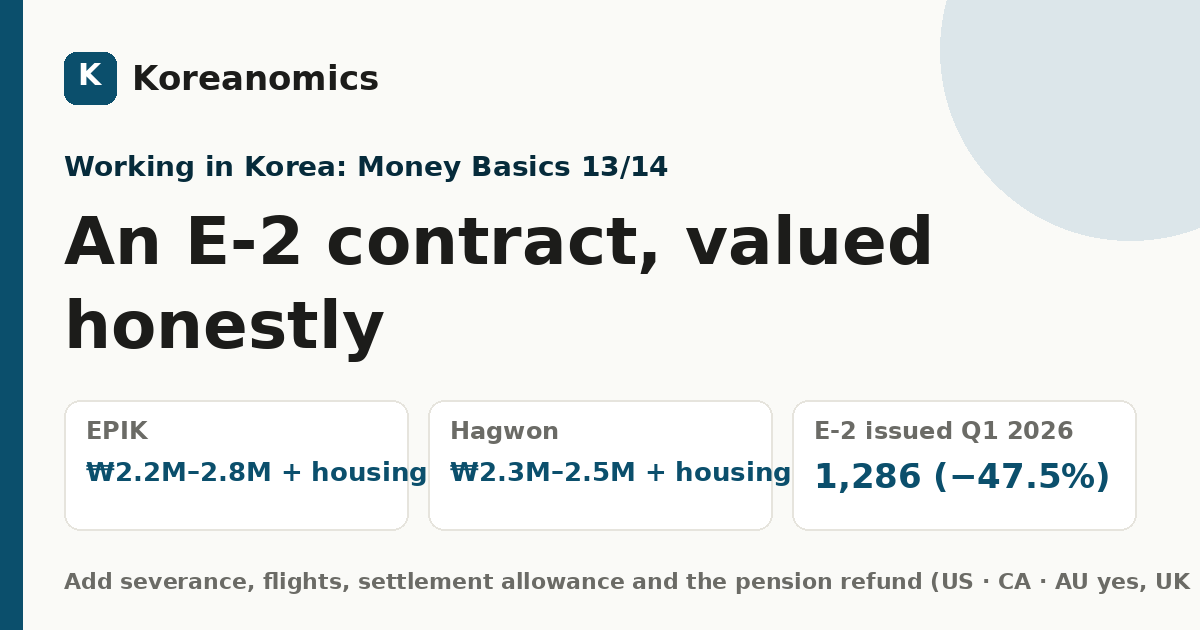
An English-teaching contract in Korea is the only common job here where the salary number is the smallest part of the story. ₩2.3M a month sounds like a graduate wage from 2010 — because it is. But a free apartment, a flight each way, a month's severance, and for some nationalities a pension refund of nearly two months' pay per year add up to a package that is worth 40–60% more than the headline. This part prices an E-2 year properly, so you can compare an EPIK posting in Jeolla with a Gangnam hagwon, or with a job at home.
E-2 contract value calculator (2026)
Severance = one month's average pay per full year (Part 5), tax-free at this size. Pension: 4.75% deducted; refund = 9.5% of pay + interest for refundable nationalities. Health 3.595% + care; employment insurance assumed not enrolled (most E-2). Income tax: single, no dependents, standard credits. Housing provided is valued at the rent figure you enter as a benefit (it is not taxable when the school provides it directly).
The two markets
EPIK and the provincial programmes (public schools) pay on a published scale — ₩2.2M for a bachelor's with no experience up to ₩2.8M for a master's or TESOL with years of experience in 2026 — plus furnished housing, ₩300,000 settlement allowance, flights, 18–26 days of paid vacation, severance, and a renewal bonus. Hours are 22 teaching hours a week within an 8:30–4:30 day, and the contract is with an education office, which pays on time. Rural postings add a ₩100,000–150,000 allowance. The programme is shrinking: Seoul's own native-teacher programme has cut to roughly 400 positions, Gyeonggi has ended most primary-school hiring, and EPIK's intake in 2026 is a fraction of its 2010s peak.
Hagwons (private academies) pay ₩2.3–2.5M for the same qualifications, sometimes ₩2.6–3.0M at large chains or for experienced teachers, with housing provided or a ₩400,000–500,000 allowance, flights, severance and 10 days of vacation. Hours run into the evening (typically 1–9 pm, 25–30 teaching hours) and the employer is a small business, which is where most pay disputes originate. The market is stable in Seoul and Gyeonggi and thinning elsewhere.
Universities pay ₩2.5–3.5M for 9–15 teaching hours and give four months of vacation; they require a master's and usually two years of experience, and hire on E-1 rather than E-2.
Pricing the package
Four things turn a ₩2.4M salary into something closer to ₩3.5M a month:
- Housing. A rent-free studio in Seoul is worth ₩600,000–900,000 a month; in a provincial city ₩400,000–500,000. If a hagwon offers an allowance instead, compare it to the real rent and remember the allowance is taxable salary while provided housing is not.
- Severance: one month's pay after 12 months, ₩2.4M on the example salary, essentially untaxed at that size (Part 5). Contracts that end at 11.5 months, or "include" severance in the salary, are trying to avoid it; both are illegal.
- Pension refund for Americans, Canadians and Australians: 9.5% of salary for every month, plus interest — ₩2.7M on a year at ₩2.4M — paid after you leave (Part 4). British, Irish and New Zealand teachers pay the same 4.75% and get nothing back but a totalised record; South Africans are not enrolled.
- Flights and settlement allowance: ₩2.5–3M for return airfare and the ₩300,000 EPIK settlement payment, usually reimbursed rather than paid in advance.
Against these, deductions at a ₩2.4M salary are about ₩114,000 pension, ₩97,600 health and care, and ₩30,000–50,000 income tax — under 11% — leaving ₩2.1–2.15M in hand. Note the 19% flat rate (Part 2) is irrelevant at these salaries; do not sign the election form if a hagwon offers it "for simplicity".
The tax-treaty exemption
The US–Korea treaty (Article 20) and several others (the UK, Ireland, Australia, New Zealand and Canada each have a version) exempt from Korean tax, for up to two years, the pay of a teacher or researcher invited by a university, college, school or other recognised educational institution. Public-school teachers under EPIK and university lecturers routinely claim it: you obtain a certificate of residence from your home tax authority (IRS Form 6166 for Americans), your employer files it, and no tax is withheld for two years. Two catches: hagwons are not recognised educational institutions, so hagwon teachers cannot claim; and the income remains taxable at home (Americans still file a US return and use the foreign earned income exclusion). The exemption covers only the first two years from arrival; from the third year normal Korean withholding applies.
What to check before signing
- Hours and what counts as an hour (teaching vs office), and the split of your salary between base and overtime.
- The housing clause: provided, or allowance, and who pays the key deposit (보증금).
- Severance stated separately, and a 12-month term.
- The four insurances listed with the employer's share (some hagwons skip employment insurance, which is legal, and health insurance, which is not).
- Whether the school has a history of unpaid wages — the Ministry of Employment and Labor publishes a name-and-shame list of habitual wage offenders, and teacher forums track hagwons.
The last part of the course is the exit: the eight things to do in your final month in Korea so that the severance, the pension refund, the tax refund and your deposit all actually arrive.
Frequently asked questions
Which nationalities can get an E-2?
Citizens of seven countries with a bachelor's degree: the United States, Canada, the United Kingdom, Ireland, Australia, New Zealand and South Africa. A criminal record check (FBI/RCMP/ACRO etc., apostilled), an apostilled degree, and a health check with drug test are required. Non-native speakers from other countries cannot teach English on E-2, though they may on E-7 or F-visas in some settings.
Is the market really shrinking?
Yes. E-2 issuance fell 47.5% year on year in the first quarter of 2026 to 1,286, as public-school programmes cut positions (Seoul's native-teacher programme is down to roughly 400 positions, not abolished as sometimes reported) and the school-age population declines. Hagwons in the capital region still hire, but salaries have barely moved in a decade while the minimum wage has doubled.
Can I get my pension back when I leave?
Americans, Canadians and Australians: yes, under social security agreements — your 4.75% plus the school's 4.75% plus interest, typically ₩2.5–3M per year of work. British, Irish and New Zealanders: no (totalization agreements only). South Africans: not enrolled in the first place, so nothing is deducted. See Part 4.
Do I pay Korean income tax?
Hagwon teachers do, from the first month, under the progressive schedule — about ₩30,000–60,000 a month at typical salaries, settled in the February year-end settlement. Public-school and university teachers from countries whose treaty has a 'teachers' article (the US and UK among them) can claim a two-year exemption; give your employer a certificate of residence from your home tax authority. The exemption does not apply to hagwons.
Sources
※ This guide is general information for foreign residents of Korea, not tax, legal or immigration advice. Rules differ by visa, nationality and tax treaty and change every year; confirm with the National Tax Service (126 → 7), NPS (1355), NHIS (033-811-2000) or Immigration (1345) before acting.