Luggage Storage in Korea (2026): Subway Lockers (T-Locker) Prices and Sizes, Seoul and Busan Station Storage, Incheon Airport Storage and Hotel Delivery, and the No-Fee Option — Cost Calculator
Seoul subway lockers cost ₩2,200–4,400 per 4 hours by size (more at weekends), paid by card or T-money. Station and airport counters, hotel delivery.
Contents
Korea's luggage problem is a good one to have: lockers in nearly every subway station, staffed storage at the big stations and airports, and delivery services that will take your suitcase from Incheon to your hotel room while you go straight to lunch. The catch is size and timing — large lockers are scarce on weekends — and prices that are quoted per four hours, not per day. This last part gives the 2026 prices, a calculator for locker versus counter versus delivery, and the free options guides forget.
Luggage storage cost calculator (Seoul, 2026)
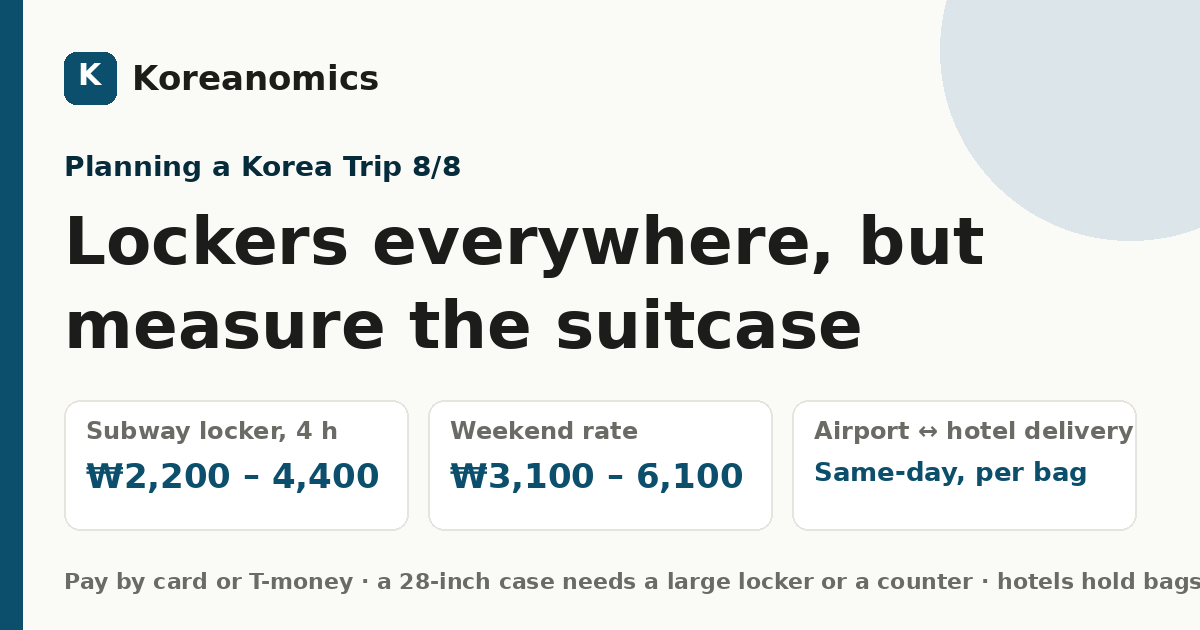
Subway T-Locker: base charge per 4 hours — weekday ₩2,200 / 3,300 / 4,400, weekend ₩3,100 / 4,600 / 6,100 (small/medium/large), then hourly overtime (modelled at 25% of the base per extra hour, capped at a daily maximum ≈ 4× base). Staffed counters (Seoul Station, Busan Station, department stores): typically ₩5,000–10,000 per bag per day. Airport ↔ hotel delivery: per-bag pricing set by the provider — enter your quote to compare.
Subway lockers (T-Locker)
Almost every Seoul subway station has a bank of lockers, usually near a main exit or the customer centre, run under the T-Locker brand for Seoul Metro. Three sizes; prices are set per 4 hours and rise at weekends and holidays:
| Size | Fits | Weekday, 4 h | Weekend, 4 h |
|---|---|---|---|
| Small | Backpack, shopping bags, a carry-on laid flat | ₩2,200 | ₩3,100 |
| Medium | A 20–24-inch suitcase | ₩3,300 | ₩4,600 |
| Large | A 26–28-inch suitcase or two carry-ons | ₩4,400 | ₩6,100 |
Overtime is charged by the hour at the terminal when you collect, with a daily cap; the maximum stay is a few days, after which the bag goes to the station office. Pay by credit card or T-money at the touchscreen (English menu); the locker is opened by a code or by tapping the same card. The T-Locker app shows live availability and lets you reserve — useful at Seoul Station, Myeongdong, Hongdae, Gangnam and Jamsil, where large lockers are gone by 10 am on a Saturday. Busan's subway (Humetro) and Busan Station have the same kind of lockers with similar prices; Daegu, Daejeon and Gwangju too.
Staffed storage
- Seoul Station: a luggage-storage desk on the concourse (and the lockers) — bags of any size, per-bag daily fee, ID required; also the pick-up point for airport delivery services.
- Busan Station, Dongdaegu, Gwangju-Songjeong and other KTX stations: lockers plus a customer-centre hold in some.
- Incheon Airport: storage counters at T1 (arrivals hall, 3F departures) and T2 run by the logistics companies, charged per bag per day by size — a day for a large case is in the range of a Seoul taxi fare, cheaper by the week; useful for a side trip to Japan or Jeju without the winter coat.
- Department stores and museums: cloakrooms at the big Lotte, Shinsegae and Hyundai stores (free or a nominal fee while you shop); the National Museum of Korea and major galleries have free lockers.
- Tourist information centres in Myeongdong and at Seoul Plaza hold bags for a small fee during opening hours.
Delivery: airport ↔ hotel, hotel ↔ hotel
Licensed luggage-delivery services take a suitcase at the Incheon arrivals counter in the morning and deliver it to a Seoul hotel by evening, or collect from the hotel for the airport on your last day. Providers include Safex, Jimcarry and the airport's own contracted same-day service; several also move bags between cities — Seoul to Busan overnight — so you can travel on the KTX with a daypack. Pricing is per bag by size and distance, posted at the counter and on the apps; peak-season slots are booked a day ahead. The economic case: two bags delivered usually costs about what a taxi would, and buys you the AREX all-stop train and an unencumbered first day.
The free option, and the trick
Hotels hold bags — before check-in, after check-out, for the day and usually for several days with a tag — and guesthouses mostly do too. On a Seoul–Busan–Seoul loop, leave the winter clothes at the Seoul hotel you are returning to. Airbnb is the exception: ask in advance.
The trick that saves the most: pack for the lockers. A 24-inch case fits a medium locker everywhere and a large one is never needed; two 20-inch cases are easier to store, carry on KTX (no size limit, but overhead racks are for carry-ons and the space behind the last row takes big cases first-come) and lift on the subway's long stairs than one 28-inch. Korea has elevators at most stations now, not all exits.
Where this leaves you
Entry rules sorted, a transit card in hand, the tax refund understood, Busan and one regional city planned, the month chosen, a jjimjilbang night in reserve and the suitcase parked: that is the trip-planning course. For the money side of living here longer — the residence card, the bank account, the phone that makes every app work — the Settling in Korea course picks up where this one ends.
Frequently asked questions
Will my suitcase fit in a subway locker?
Small lockers take a backpack or a carry-on laid flat; medium take a 20–24-inch case; large take one 26–28-inch case or two carry-ons. Most stations have far more small and medium than large, and the large ones at Seoul Station, Myeongdong and Hongdae are full by mid-morning on weekends. Reserve a large one in the T-Locker app or use a staffed counter.
How do I pay and get it back?
At the touchscreen (English available): choose a free locker, put the bag in, pay by credit card or T-money — the machine prints or texts a code, or ties the locker to your card. To retrieve, enter the code or tap the card; overtime is charged at the same screen. Bags left beyond the maximum period (usually 3 days, sometimes 7) are moved to the station office.
Can I send my bags from the airport to the hotel?
Yes. Several licensed services (Safex, Jimcarry and others; counters at Incheon T1 and T2 arrivals, and at Seoul Station) take a suitcase in the morning and deliver it to a Seoul hotel the same day, or the reverse for your departure day; the airport also runs a same-day baggage delivery contract. Prices are per bag by size and are posted at the counter — expect the price of a taxi ride split across a couple of bags. Book online a day ahead in peak season.
Is there a free option?
Your hotel. Every hotel and most guesthouses hold luggage before check-in and after check-out at no charge, usually for the day and often for several days; Airbnb hosts vary. Department stores and some museums (National Museum of Korea, Seoul Museum of Art) have free or cheap cloakrooms, and the Seoul Station 'Seoul Luggage Storage' desk and tourist information centres in Myeongdong hold bags for a small fee.
Sources
※ This article summarises publicly available rules as of the date shown. Your situation may differ; confirm with the relevant Korean authority (National Tax Service, Ministry of Employment and Labor, National Pension Service, Immigration) or a licensed professional before making decisions.