Busan in 2 or 3 Days (2026): Haeundae, Gwangalli's Saturday Drone Show, Gamcheon, Jagalchi, Taejongdae, Spa Land — Itinerary, Fares After the KTX–SRT Merger, and What to Skip
Two days covers the beaches, Gamcheon and the markets; a third earns Taejongdae, Yonggungsa and Spa Land. KTX from Seoul ₩54,400 since Sept 2026. Drone show.
Contents
Busan is Korea's second city and its only real seaside one: beaches inside the city, a fish market the size of a stadium, a hillside village painted every colour, and a Saturday-night drone show that costs nothing. It is also long and thin — 30 kilometres from the eastern temple to the western cliffs — which is why the honest plan is two full days at minimum and three if you can. This part gives the itinerary, the fares after the September 2026 rail merger, and the things worth skipping.
Getting there
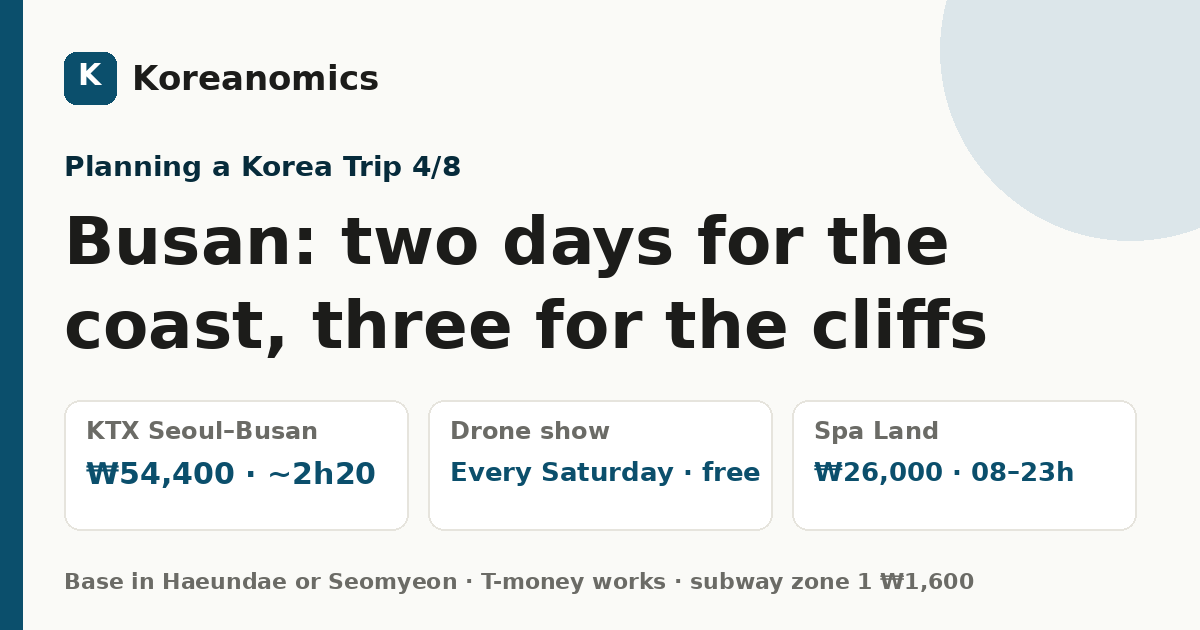
KTX from Seoul Station (or Suseo, since the merger) to Busan Station: ₩54,400 standard class, about 2 hours 20 minutes on the fastest services (up to 3 hours with stops), 50+ departures a day. Since September 1, 2026 KTX and SRT run as one system — book on korail.com or the KorailTalk app (English, foreign cards), where the former SRT trains appear as KTX-Sancheon from Suseo. First class adds ~40%; the KORAIL Pass (2, 3, 4 or 5 days, foreigners only) pays off if you are also going to Gyeongju or Gangneung (Part 5). Flying Gimpo–Gimhae takes an hour but airport transfers eat the saving. Express bus from Seoul is 4–4.5 hours and around ₩30,000–45,000.
From Busan Station the subway (line 1) reaches Nampo in 3 minutes and Seomyeon in 10; Haeundae is 45 minutes with a change to line 2. From Gimhae Airport, the light rail + line 2 to Haeundae takes about an hour, a taxi 30–40 minutes (₩30,000–40,000). T-money works on everything; the fares are ₩1,600 (zone 1) and ₩1,800 (zone 2, e.g. Busan Station–Haeundae), bus ₩1,550, taxi from ₩4,800.
Day 1 — the west: markets, Gamcheon, the harbour
Start at Jagalchi Market (line 1, Jagalchi) — the fish hall opens early, and the upstairs restaurants cook whatever you buy downstairs for a small fee; it is at its best before 11. Walk through Gukje Market and BIFF Square (street food: ssiat hotteok, the seed-stuffed pancake) to Bosu-dong Book Street. Take bus 2-2 or a taxi up to Gamcheon Culture Village: free to walk, a map from the information centre (₩2,000) is the point of the visit, and two hours is enough; go before 3 pm for the light. Descend to Songdo for the Busan Air Cruise cable car over the sea to Amnam Park (standard and glass-floor cabins; check current fares on site) or, if you would rather walk, the Huinnyeoul Culture Village cliff path on Yeongdo. End at Yongdusan Park and the Busan Tower or on the Nampo-dong side of the harbour for dinner — this is the seafood-and-soju side of the city.
Day 2 — the east: Haeundae, Yonggungsa, Gwangalli
Morning at Haeundae Beach; walk the coastal Dongbaekseom loop (45 minutes, free) past the APEC house, or take the Haeundae Blueline Park beach train or sky capsule along the old railway to Songjeong (book ahead on weekends). Then a bus or taxi to Haedong Yonggungsa, the temple on the rocks — free, crowded by 11, best at opening (05:00) or late afternoon. Back in Centum City, Spa Land at Shinsegae (₩26,000 adult, ₩16,000 after 7 pm, 08:00–23:00, no under-7s — see Part 7) is the afternoon's rest. Evening at Gwangalli Beach: the bridge lights, the bars along the front and, on Saturdays, the drone show (Every Saturday · Mar–Sep 20:00 & 22:00 · Oct–Feb 19:00 & 21:00, about 12 minutes, free — arrive 30 minutes early). Non-Saturday evenings: the Haeundae night market or Millac Waterside Park for a beer facing the bridge.
Day 3 — cliffs, views, a slower pace
Taejongdae on Yeongdo: a cliff park with a lighthouse and a road-train loop (about 90 minutes; small fare); combine with Huinnyeoul if you skipped it. Then either Busan X the Sky (the 100th-floor observation deck in the Haeundae LCT tower — the view is the whole coast) or Igidae Coastal Walk below Gwangalli for the free version. Lunch on dwaeji gukbap, the pork-rice soup that is Busan's signature (Seomyeon's gukbap alley). Afternoon options: the Busan Museum of Contemporary Art, the Oryukdo Skywalk (free), or Gijang's crab market and the Ilgwang beach cafés to the north. If the day is Saturday and you missed Gwangalli on Day 2, swap.
Passes and buses
The Busan City Tour Bus (₩20,000, ₩19,000 online, children ₩10,000) loops Busan Station → Yonggungsa → Haeundae → Gwangalli with hop-on/off — worth it on Day 2 if you dislike bus changes. The Visit Busan Pass (24- and 48-hour versions, sold online and at Busan Station) bundles admission to X the Sky, Spa Land, the cable car, the Blueline train and others: it pays off only if you do three or more paid attractions in a day — price and included list change yearly, so check visitbusanpass.com against your plan before buying.
Eating
Dwaeji gukbap (pork rice soup), milmyeon (cold wheat noodles), ssiat hotteok, hoe (raw fish) at Jagalchi or Millak Raw Fish Town, eomuk (fish cake) at the markets, and — on the Haeundae side — the crab and grilled shellfish restaurants of Gijang and Cheongsapo. Busan is Korea's least Seoul-priced big city: a bowl of gukbap is ₩9,000–10,000, a fish dinner for two ₩50,000–80,000.
Skip, or manage expectations
Haeundae's beach itself is a summer crowd scene (July–August) and a wind-blown promenade otherwise — it is the neighbourhood, not the sand, that you are there for. Gamcheon is beautiful and small; it does not need a half-day. Busan Tower is modest next to X the Sky. The Nurimaru APEC House is a ten-minute stop. And if it rains: Spa Land, the Shinsegae Centum City mall (the world's largest department store), the aquarium at Haeundae and the Museum of Contemporary Art will fill the day.
Busan is the obvious second city; the next part is about the ones most itineraries miss — Gyeongju, Jeonju, Gangneung, Andong and the others within two hours of Seoul or Busan by KTX.
Frequently asked questions
Is Busan a day trip from Seoul?
Physically yes — 2 hours 20 minutes each way on KTX — but it wastes the best of it. Busan's attractions are spread along 30 km of coast and its evenings (Gwangalli's bridge lights, the Saturday drone show, the Haeundae night market) are the point. Two nights is the minimum that makes the train fare worthwhile; three lets you add the eastern temple, Taejongdae and a spa afternoon.
What changed with the trains in 2026?
KTX and SRT were merged into one operation on September 1, 2026: the SRT brand became 'KTX-Sancheon', all trains are booked on the Korail app or site, Suseo-departing trains earn the same mileage, and fares fell about 10% — Seoul–Busan standard class is now ₩54,400 (was ₩59,800). Book on korail.com or the KorailTalk app in English; foreign cards work; seats on Friday evening and Sunday afternoon sell out.
Haeundae or Seomyeon — where to stay?
Haeundae for the beach, the Centum City spa and the eastern sights (Yonggungsa, Songjeong); Seomyeon or Nampo for the markets, Gamcheon, Taejongdae and the western side, with cheaper rooms and more restaurants. From Haeundae to Nampo is 45–60 minutes by subway line 2 → 1, so a two-night stay usually picks one base and spends one full day on the other side.
When is the drone show?
Every Saturday over Gwangalli Beach, free, year-round: 20:00 and 22:00 from March to September, 19:00 and 21:00 from October to February, about 12 minutes each. It is cancelled for wind, rain and occasional city events, and the beach fills 30 minutes before — the bars along the front sell out the window seats by 18:00.
Sources
- Busan Metropolitan City — Gwangalli M Drone Light Show schedule (official)
- Kyunghyang / Korea Daily — KTX–SRT integration from September 1, 2026, fares cut ~10%
- Busan City Tour Bus — routes and fares (official)
- Visit Busan (official tourism site) — attractions, Visit Busan Pass
- Busan Metropolitan City — urban rail and bus fares
※ This article summarises publicly available rules as of the date shown. Your situation may differ; confirm with the relevant Korean authority (National Tax Service, Ministry of Employment and Labor, National Pension Service, Immigration) or a licensed professional before making decisions.