Korea Weather and What to Pack by Month (2026): Seoul Temperatures, Monsoon and Typhoon Season, Fine Dust, Cherry Blossom and Foliage Timing, and the Record Heat of 2025–2026
Seoul swings from −6°C in January to 30°C in August with a July monsoon. Monthly averages, rainy and dusty seasons, blossom and foliage windows, packing list.
Contents
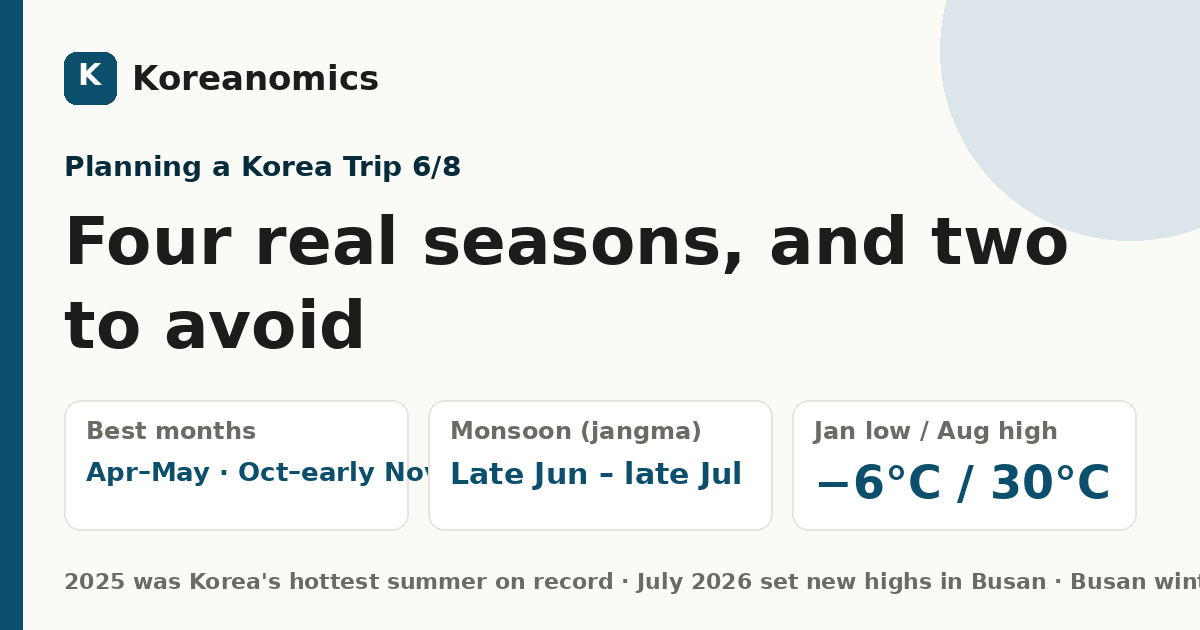
Korea has four seasons that behave, plus two stretches that punish an unprepared visitor: the July monsoon and the January cold. Its climate is continental with a summer monsoon — hotter in summer and colder in winter than its latitude suggests — and the last two summers have been the hottest on record. This part gives the Seoul monthly averages, the seasonal hazards, the blossom and foliage windows, and a month-selector that tells you what to pack.
What to pack — by month and region
Seoul figures are 30-year climatological normals (KMA 1991–2020), rounded. Busan: winters ≈ +5°C, summers ≈ −1°C and wetter in July; Jeju milder still and windier; mountains ≈ −5°C with earlier snow and foliage. Recent summers have run 1–2°C above these normals.
Seoul, month by month
| Month | High / low (°C) | Rain (mm) | What it is like |
|---|---|---|---|
| Jan | 2 / -6 | 15 | Cold, dry, often sunny; wind chill; ski season |
| Feb | 5 / -4 | 30 | Cold, dry, often sunny; wind chill; ski season |
| Mar | 11 / 1 | 35 | Thawing; fine-dust days begin; plum blossom |
| Apr | 18 / 7 | 75 | Cherry blossom (first week); mild; dust risk |
| May | 24 / 13 | 105 | The best month: warm days, cool nights, green |
| Jun | 28 / 18 | 130 | Warm and humid; monsoon starts in the last week |
| Jul | 29 / 22 | 415 | Monsoon: heavy rain, 90% humidity, hot between fronts |
| Aug | 30 / 23 | 350 | Hottest; tropical nights; typhoon risk |
| Sep | 26 / 17 | 140 | Humidity breaks mid-month; Chuseok; typhoon tail |
| Oct | 20 / 10 | 50 | Clear, dry, 15–22°C; foliage starts in the hills |
| Nov | 12 / 3 | 50 | Foliage peaks early; cold arrives late month |
| Dec | 4 / -4 | 25 | Cold, dry, often sunny; wind chill; ski season |
Busan runs about five degrees warmer than Seoul from October to April, one degree cooler in high summer, and wetter in July; it rarely sees snow. Jeju is milder and windier, with the typhoon exposure. The mountains — Seoraksan, Jirisan, the ski areas of Gangwon — are five degrees colder than Seoul, with snow from December and foliage two weeks earlier.
The seasons that need planning
Jangma, the monsoon (late June to late July): a stationary front oscillates over the peninsula and brings days of rain — 400 mm in Seoul in July, more in Busan — with humid heat between the bursts. 2026's front arrived unusually late, not reaching Korea until the second week of July. It is a poor month for beaches and the mountains; museums, spas (Part 7), department stores and underground shopping streets are the plan.
Heat: August averages hide the reality. Summer 2025 was Korea's hottest on record (national mean 25.7°C, 28 heatwave days), and on July 29, 2026 Yangsan near Busan hit 40.3°C and Busan itself 38.8°C, both records. Plan indoor afternoons, early mornings for sights, and hydration; the government's heat alerts arrive by phone.
Typhoons (August–September): one or two a year affect the south coast and Jeju, with a day of cancelled ferries and flights and a night of rain; Seoul usually gets the tail. Check the KMA app or news two days ahead.
Fine dust and yellow dust (March–May, sometimes winter): PM2.5 episodes of one to three days when the air-quality index goes orange or red; KF94 masks are sold everywhere and most Koreans wear them on those days. The rest of the year is generally clear.
Cold (December–February): Seoul's daytime highs sit near freezing, with cold snaps to −15°C and a dry wind. The upside is sunshine, empty palaces, and the cheapest hotel rates of the year; the ski resorts of Gangwon are an hour or two from Seoul.
Blossom and foliage windows
Cherry blossom moves north: Jeju and Busan in the last week of March, Gyeongju and Daegu at the turn of the month, Seoul in the first week of April (Yeouido's festival, Seokchon Lake), with year-to-year variation of a week either way — the KMA publishes a forecast in early March. Autumn foliage moves south and down: Seoraksan from early October, the central mountains mid-October, Seoul's Namsan and the palaces from late October to early November, Busan and Jeju into mid-November. Both are two-week windows; book accommodation in Seoul and Gyeongju months ahead for them.
Holidays that change the plan
Seollal (Lunar New Year, January or February) and Chuseok (September or October) are three-day national holidays when trains and roads jam for two days each side, many restaurants and small shops close, and palaces open free. Check the dates for the year; the days between the travel crush are wonderful for Seoul itself. Public holidays in May (Children's Day, Buddha's Birthday) and the first week of October (Foundation Day, Hangul Day) also fill hotels.
Packing, in one list
Layers all year; a serious umbrella from June to September; a warm coat and thermal layer from December to February; comfortable walking shoes (Seoul sightseeing is 15,000–20,000 steps a day); a KF94 mask or two in spring; sunscreen (Korean sunscreens are excellent and cheap — buy them here); deodorant (hard to find in shops); a universal adapter for 220 V type C/F sockets; and nothing at all for the baths of a jjimjilbang, which is the next part.
Frequently asked questions
When is the best time to visit?
Late March to May and late September to early November. Spring has cherry blossom (Seoul usually peaks in the first week of April, Busan a week earlier) and mild days, with the caveat of fine-dust episodes in March–April; autumn has clear skies, 15–22°C afternoons and foliage from mid-October in the mountains to early November in Seoul. Summer is hot, humid and wet; winter is cold and dry but sunny, and cheap.
How bad is the monsoon?
Jangma runs roughly from late June to late July: a stalled front that brings days of heavy rain, then steaming heat between bursts. It is not a washout every day, but it makes the northern mountains and beaches unreliable and floods low streets in Seoul occasionally. In 2026 the front arrived late, not reaching Korea until after the first week of July. Typhoons are an August–September risk, mostly for the south coast and Jeju, usually one or two brushes a year.
What is the fine-dust warning?
Spring (March–May) brings yellow dust from the Gobi and domestic fine particulates (PM2.5) that can push the air-quality index into 'bad' for a day or three at a time. Koreans check the daily forecast and wear KF94 masks on bad days; it is an inconvenience for a healthy visitor, a real issue for asthma. Autumn and summer are usually clear.
Do I need a heavy coat in winter?
Yes for Seoul, from December through February: daytime highs around 2–5°C, nights to −6°C or below, with wind that makes it feel colder and occasional cold snaps to −15°C. Indoor heating (ondol floors) is strong, so layers matter more than bulk. Busan and the south coast are 5–6 degrees warmer and rarely freeze for long; Jeju is milder still.
Sources
- Korea Meteorological Administration — Seoul climatological normals (1991–2020), monthly temperature and precipitation
- Stars and Stripes Korea / KMA — Summer 2025 the hottest on record (national average 25.7°C)
- Korea JoongAng Daily — 2026 monsoon delayed until July
- Tech Times / KMA — July 29, 2026: Yangsan 40.3°C, Busan 38.8°C records
※ This article summarises publicly available rules as of the date shown. Your situation may differ; confirm with the relevant Korean authority (National Tax Service, Ministry of Employment and Labor, National Pension Service, Immigration) or a licensed professional before making decisions.