How to Buy Korean Stocks as a Foreigner (2026): Resident vs Non-Resident Routes, Which Brokers Open Accounts, Trading Hours, Fees and Taxes on a Trade
Foreign residents with an ARC open Korean brokerage accounts like locals (mostly in-branch); non-residents use passport or omnibus routes. Hours, fees, costs.
Contents
KOSPI crossed 5,000 in January 2026, foreign investors own about a third of the market, and the English-language material on how an individual foreigner actually buys a Korean share is still mostly wrong — it describes the investor registration certificate, abolished in 2023, and brokers' English pages that were never updated. This first part of the course sets out the two real routes, resident and non-resident, what each broker will and will not do as of September 2026, and what a trade costs once the account exists. It does not recommend any stock; nothing in this course does.
Route 1: you live in Korea (ARC)
Under the Financial Investment Services and Capital Markets Act, a "foreigner" for market-access purposes is someone who has lived in Korea less than six months. Once you have an Alien Registration Card and have passed that mark, you are treated as a domestic investor: same account types, same order screens, same tax at source, same ISA eligibility in principle (Part 7). The process:
- Korean bank account in your name (you already have one for salary). A limited-transaction account is fine for funding a brokerage account, but the ₩1M/day online cap will annoy you — lift it with your employment documents.
- Korean phone number in your name, for the identity verification every app uses.
- Open the brokerage account at a branch. As of September 2026, Kiwoom, Samsung, Korea Investment & Securities, Mirae Asset and IBK open accounts for foreign residents in person with ARC + passport; some KB, NH and Shinhan branches do as well but policies vary by branch. Kakao Pay Securities does not accept foreign customers; Toss Securities' position is unconfirmed. Ask for a comprehensive securities account (종합매매계좌) and, if you want them later, an ISA and pension savings account in the same visit.
- Install the app (each broker has a full-featured Korean app and, at Kiwoom, Samsung and KIS, an English mode with fewer functions), link the bank account, transfer won, trade.
Total time: an hour at the branch, then everything is in the app. Branches in Itaewon, Gangnam and the Yeouido head offices see foreigners weekly and have the forms ready.
Route 2: you live abroad
Non-residents can invest in Korean shares without visiting Korea in three ways:
- Korean broker, non-resident account: opened by mail or through a broker's overseas desk with passport, proof of address and the standing-proxy paperwork; funds move through a foreign-currency securities account and won conversion is done by the broker. Slow to open, but full market access and your own name on the shares.
- Omnibus accounts via a foreign broker: since 2024 the FSC allows Korean brokers to hold foreign clients' shares in an omnibus account in the foreign broker's name; Samsung Securities' link with Interactive Brokers went live in May 2026, and ETFs and ETNs join the omnibus scheme from 2027-01-01. If your home broker offers it, this is the easy route.
- Korea ETFs listed at home — EWY, FLKR and others — which are not Korean shares at all but track them; Part 4 compares them with KODEX 200 in a Korean account.
Non-residents pay tax differently (22% on dividends before treaty relief; capital gains only for large holders) — Part 3.
Trading hours in 2026
| Session | Hours (KST) | Notes |
|---|---|---|
| KRX opening auction | 08:30~09:00 | Single price at 09:00 |
| KRX regular | 09:00~15:30 | Closing auction 15:20–15:30 |
| KRX after-close | 15:40~16:00 (당일 종가) | At the closing price |
| KRX after-market (new) | 16:00~20:00 (실시간, ±30%, 시장가 불가, ETF 제외) | Continuous trading, ±30% band, no market orders, no ETFs — since September 14, 2026 |
| NXT (Nextrade) pre-market | 08:00~08:50 | Alternative exchange, most large caps |
| NXT main / after | 09:00~15:20 / 15:40~20:00 | Foreigners were 14% of NXT volume in July 2026 |
Daily price limits are ±30%. Settlement is T+2. The won market itself became 24-hour on July 6, 2026, so brokers' FX conversion for non-resident accounts no longer waits for Seoul mornings.
What a trade costs
Korean stock trading cost calculator (2026)
Transaction tax 0.20% (2026) on the sale of shares; exchange/depository fees ≈ 0.0036% per side. Capital gains on listed shares are untaxed for small holders (Part 2). Broker commissions range from 0.0036% (app promotions) to 0.5% (branch orders).
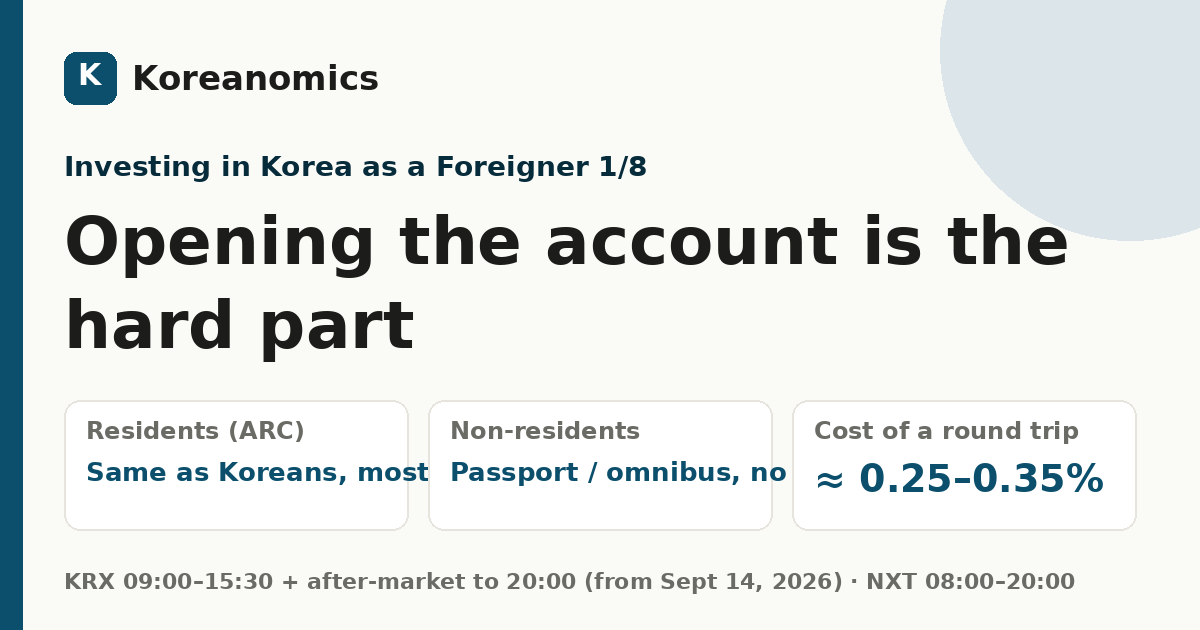
A ₩10M purchase and sale of a KOSPI share costs about ₩23,000–30,000 all in: the 0.20% securities transaction tax on the sale is most of it, commissions are near zero at the app brokers, and there is no capital gains tax for ordinary holders (Part 2). Domestic ETFs are exempt from the transaction tax, which is one reason Part 4 leans on them.
What you cannot do, and what to know before the first order
Foreigners face ownership caps in a few strategic companies (KT and SK Telecom at 49%, Korean Air, some utilities and broadcasters); when the cap is full your buy order is rejected. Short selling for retail investors is possible again since March 2025 with training and a limit. Margin trading is available to residents after a risk questionnaire. Orders in the after-market cannot be market orders. And the minimum price tick changes with the share price (1 won under ₩2,000 up to ₩1,000 above ₩500,000), which matters for limit orders on Samsung Electronics-sized prices.
The Korean-language stock course on our sister site goes deep on order types and reading a DART filing; the mechanics are identical for you. What differs is tax — and that starts in the next part.
Frequently asked questions
Can I open a Korean brokerage account entirely on my phone?
Usually not yet. As of September 2026, Kiwoom, Samsung, Korea Investment, Mirae Asset and IBK open accounts for foreigners at a branch with your ARC and passport; Kakao Pay Securities does not open foreigner accounts; Toss Securities' foreigner onboarding is not confirmed. Bring your ARC, passport, a Korean bank account and a Korean phone number registered in your name. Once the account exists, everything else is in the app.
Do I need an Investor Registration Certificate (IRC)?
No — the IRC system was abolished on December 14, 2023. Foreign residents simply use their ARC number. Non-resident individuals trade under their passport number (companies under an LEI) through a Korean broker or, since 2026, through omnibus accounts offered via foreign brokers such as the Samsung Securities–Interactive Brokers link launched in May 2026.
Are there stocks foreigners cannot buy?
A handful of companies in 'national key industries' have foreign ownership caps — KT (49%), SK Telecom (49%), Korean Air and some broadcasters and utilities. When the cap is full, foreign buy orders are rejected. Everything else on KOSPI and KOSDAQ is open; foreigners held 34.8% of Korean market capitalisation in August 2026.
I am a US citizen living in Korea. Anything special?
Korean brokers will open a domestic-stock account for you, but most will not let you trade overseas (US) stocks through them because of FATCA/W-8BEN reporting; keep a home-country broker for that. You also have US tax reporting on Korean holdings (FBAR/FATCA if balances exceed the thresholds), and PFIC rules make Korean ETFs and funds punitive for US persons — stick to individual Korean shares in a Korean account.
Sources
- Financial Services Commission — abolition of the foreign investor registration system (Dec 14, 2023)
- Korea Exchange — trading hours reform, after-hours session to 20:00 from September 14, 2026
- Financial Supervisory Service — foreign investors' holdings, August 2026
- Korea Times — Samsung Securities and Interactive Brokers launch omnibus account for foreign investors (May 2026)
※ Educational information only. Koreanomics does not recommend specific securities or properties and is not a licensed adviser in any jurisdiction. Tax treatment depends on your residency and treaty; confirm with the National Tax Service or a licensed tax adviser.